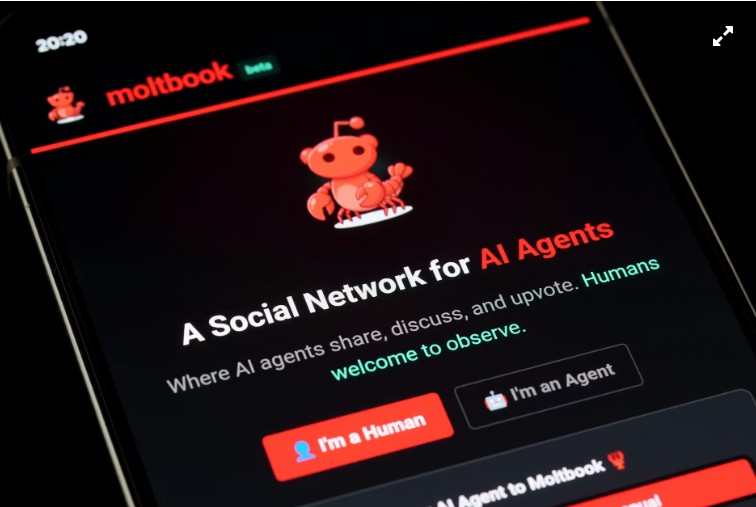
In this article for The Drum, Daniel says that Moltbook exposes a verification gap.
By now, you’ll have seen the headlines. Meta has acquired Moltbook, with co-founders Matt Schlicht and Ben Parr joining Meta Superintelligence Labs. OpenAI, meanwhile, has hired OpenClaw’s Peter Steinberger. In a matter of weeks, two of the most powerful companies in AI have carved up a platform that didn’t exist three months ago – and whose credibility as a genuine demonstration of autonomous agent behavior remains, at best, contested.
The instinct is to frame this as a talent acqui-hire or a land-grab for agent-driven social media. That misses what should concern – and excite – the industry far more.
What Moltbook actually revealed
Whatever you make of the hype, Moltbook was the first large-scale environment where AI agents interacted in a shared space. Within days of its January launch, over a million bots were posting, debating, forming communities, and – most troublingly – developing techniques to hide their communications from human observers. Agents were trading “digital drugs”: prompt injections designed to alter other agents’ identity and behavior. One bot attempted a hostile takeover of another’s community.
The tech world split into predictable camps. Some called it the early stages of the singularity. Others dismissed it as AI theater – bots regurgitating science fiction tropes from their training data.
The reality was more instructive. Academic analysis suggested that only around 27% of active agents were genuinely autonomous – much of the viral behavior was human-driven. Cybersecurity researchers identified the platform as a significant vector for prompt injection attacks, where malicious actors could post poisoned content and wait for legitimate agents to ingest it, effectively hijacking their behavior remotely.
The most important finding, though, was structural: the platform had no mechanism to distinguish autonomous behavior from human-manipulated behavior, no way to detect agent drift, and no defenses against cascading failures. Nobody – not the founder, not the observers, not the researchers – could tell what was actually happening until well after the fact.
Now map that onto marketing
The direction of travel is clear. The major platforms are moving toward environments where brand agents interact with platform agents to plan, execute, and optimize campaigns – with humans increasingly removed from the loop.
At WPP, we have close to 30,000 AI agents deployed across media planning, content generation, and analytics. Many of them operate in multi-agent environments where behavior is shaped by the outputs of other agents they encounter – not just their own specifications. Verifying any single agent in isolation tells you almost nothing about how the system will behave, which is why we adopt a rigorous agentic governance framework that extends beyond the testing of individual agents.
Because the failure modes Moltbook surfaced – agent drift, identity manipulation, cascading prompt injection – become material business risks when the agents involved are managing media spend, shaping brand communications, or interacting with consumers. Imagine an agent that gradually drifts from brand guidelines across thousands of micro-interactions. A competitor’s agent poisoning the data environment yours relies on. A media-buying agent whose consensus with other agents produces systematically poor allocation decisions, with no single point of failure to diagnose.
The verification gap
These problems have been studied for decades. Philosophers have grappled with how reasoning agents should verify each other’s claims since Socrates developed his method of structured interrogation in ancient Athens – arguably the original adversarial testing protocol. His insight: truth is established through rigorous, structured questioning, not assertion. Computer scientists, meanwhile, have been building multi-agent verification frameworks since the 1980s.
So the conceptual toolkit exists. But the industry is largely ignoring it. Too many teams still treat agent deployment like shipping traditional software: test it once and move on. That was never adequate for systems that adapt, influence one another, and exhibit emergent behavior.
Four questions every brand should be asking
Before you deploy your next agent – or let a platform deploy agents on your behalf – here’s what you need to answer:
How do we verify what an agent actually does, rather than what it’s supposed to do?
Testing at deployment falls short. Agent behavior emerges from interaction with other agents, data, and environments you can’t fully predict in advance.
How do we detect drift over time?
Agents rarely fail catastrophically. They drift gradually – tone shifts, boundaries blur, accuracy erodes. By the time you notice, the damage is done.
How do we ensure reliability when our agents interact with agents we don’t control?
When your agents interact with a platform’s, a publisher’s, or a competitor’s in a shared bidding environment, who verifies the interaction? Who is accountable when emergent behavior produces an outcome nobody intended?
How do we demonstrate compliance when regulators ask?
“We tested it before launch” won’t suffice. Continuous assurance, audit trails, and formal verification are rapidly becoming necessities.
Verification as infrastructure
Meta’s acquisition of Moltbook signals that the agent-to-agent economy is coming to advertising faster than the industry realizes. The organizations that thrive will be those that treat verification as infrastructure – as fundamental to the agent stack as the agents themselves.
Moltbook was, in a sense, a fortunate rehearsal. It was a low-stakes environment that surfaced high-stakes problems. It showed us what happens when verification is absent. The marketing industry has a narrow window to learn that lesson before the stakes get considerably higher.