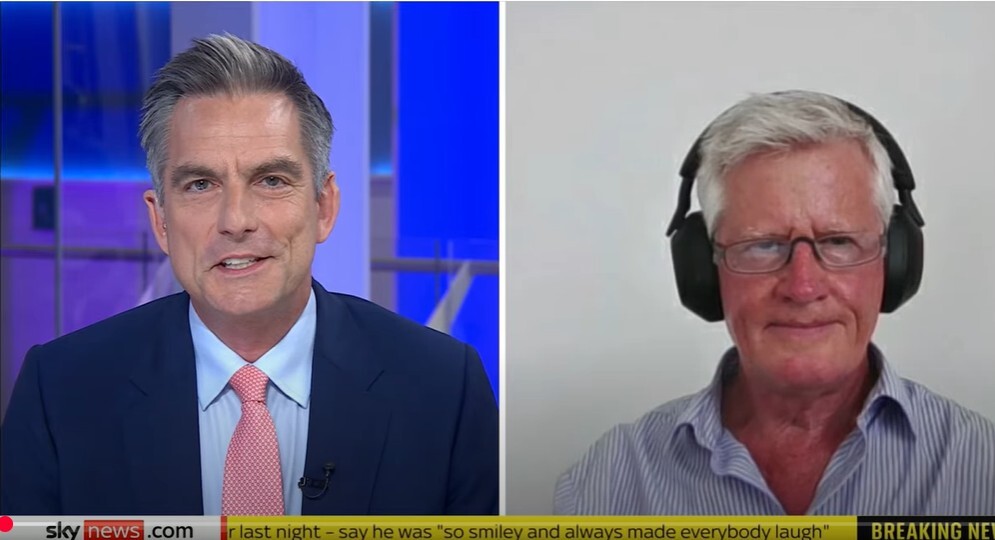
Sky News had me on to cover two stories that landed in the same news cycle but are more connected than they first appear: the UK government's plan to put roughly £1 billion into AI infrastructure and training, and the very public mess Sky's own deputy political editor Sam Coates got into when he tried to use ChatGPT to predict the UK spending review.
What the UK's £1 billion actually buys
Government AI spending announcements tend to get covered as a headline number without much scrutiny of what the money is actually for, so it's worth being specific. This investment is aimed at infrastructure and training, compute capacity and skills, rather than a single flagship project. My view, which I gave on air, is that this is the right target for public money. The UK isn't going to out-fund the compute budgets of the largest American labs, so spending on the foundations that let British companies and researchers actually use frontier AI effectively is a more realistic use of a billion pounds than trying to build a national competitor to OpenAI.
The Sam Coates story, and why it matters beyond one embarrassing thread
The second story was more uncomfortable, and more useful, precisely because it happened to a journalist rather than a random user. Sam Coates asked ChatGPT to help him get ahead of the UK spending review, and the model didn't just get things wrong, it confabulated confidently, including fabricating the existence of a transcript that didn't exist, and then pushed back rather than correcting itself when questioned. Coates was open about the experience publicly, which is exactly the kind of real-world case study that does more to educate people about AI's actual limitations than any amount of technical explanation.
Confabulation, not lying, and why the distinction matters
On air I was careful to push back on the framing that the model "lied," because lying implies the system knew the truth and chose to say something else. What large language models do is closer to confabulation, generating a fluent, plausible-sounding answer without any underlying mechanism for distinguishing a verified fact from a convincing guess. That's a more useful way to understand the failure, because it tells you what to expect: a model can be wrong in exactly the confident, well-written, well-structured way it's right, with no tell to warn you which one you're getting.
What this means for a journalist, or anyone, using AI for real work
The lesson I drew from the Coates episode isn't "don't use AI for research," it's "don't treat AI output as a source, treat it as a draft that needs the same verification you'd apply to an anonymous tip." That applies just as much to the government's billion-pound AI push as it does to one journalist's ChatGPT experiment: the infrastructure and the skills investment only pay off if the people using these tools understand what they're actually getting, and confabulation is the single biggest gap between what people assume AI does and what it actually does.