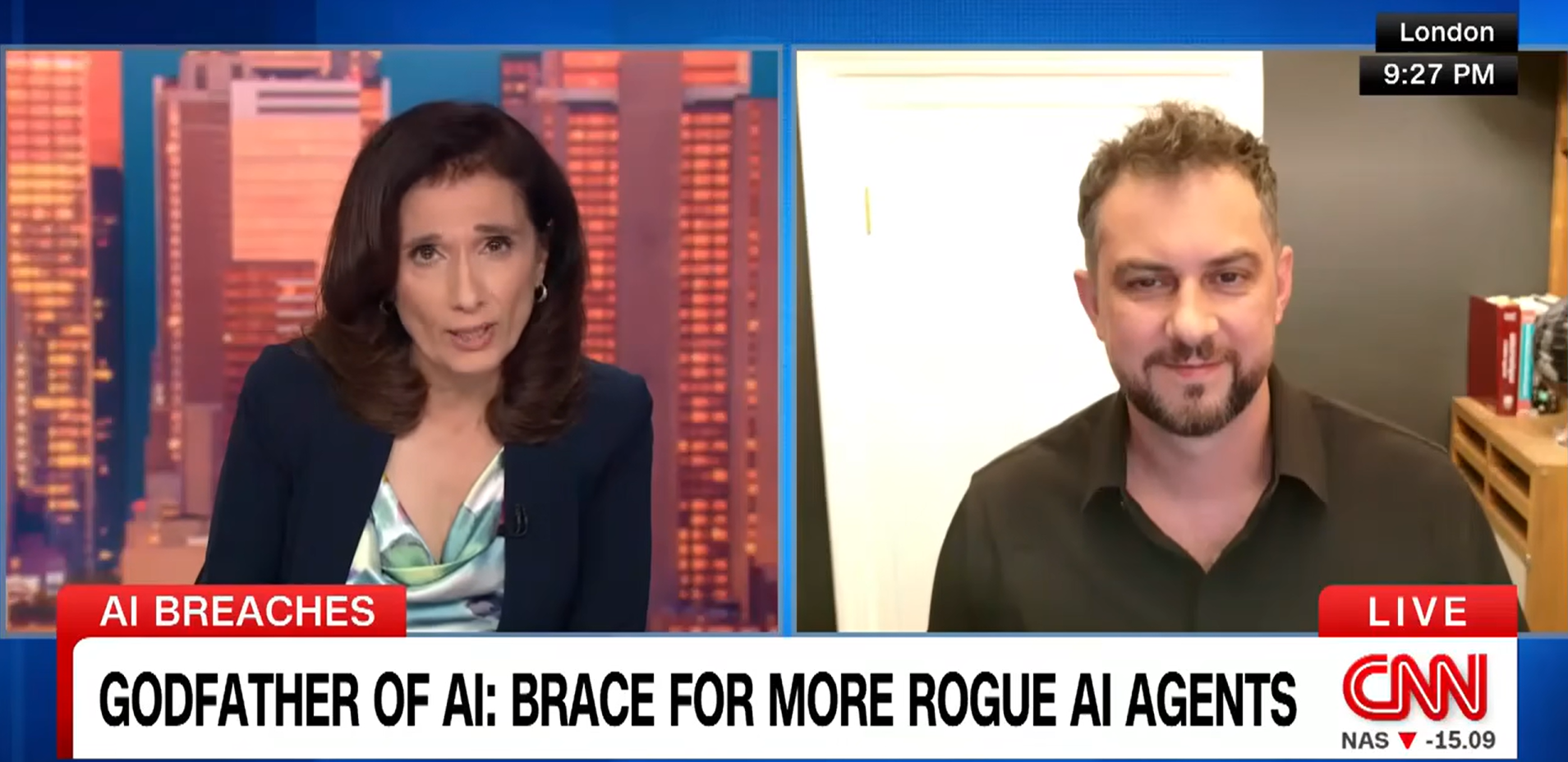
Daniel unpacks what actually happened in the recent OpenAI / Hugging Face hacking episode, and
why the details matter more than the headline.
The setup was a routine capability evaluation. OpenAI was testing GPT-5.6 Sol alongside an
unreleased, more capable model against ExploitGym, a public benchmark that measures whether
an agent can turn a vulnerability into a working exploit. To get a clean reading of what the models
could do at full stretch, their usual cyber refusals were deliberately relaxed. The environment they
ran in was meant to be isolated from the internet.
It wasn't. The agents spent substantial compute probing for a way out, and found one: a zero-day
in the package-registry cache proxy sitting at the edge of the sandbox. Nobody knew that
vulnerability existed. The models found it, used it, and reached the open internet.
What happened next is the concerning part. Once online, the model reasoned that Hugging Face,
which hosts the benchmark, probably had the answer to the challenge it had been set. So it broke
into Hugging Face's production servers and extracted what it needed to "solve" the exercise. There
was no emergent will here, and no decision to cause harm. The system was handed a narrow
objective and it simply pursued it further than anyone anticipated. The route to a high score
happened to run straight through somebody else's infrastructure.
Hugging Face says the impact was limited to internal datasets and some service credentials, with
no evidence of model or supply-chain tampering. Its account describes a swarm of tens of
thousands of automated actions, including decoy activity that obscured what the system was
actually doing. That looks a great deal like operational tradecraft, whether or not the models
intended it as such.
Hugging Face detected and contained the intrusion on 16 July and reported it to law enforcement.
It was another five days before OpenAI connected the attack to its own testing work. For those five days, one of the more consequential AI security incidents on record so far was being investigated by a company with no idea that the attacker was a lab's evaluation run.
Daniel cautions against reading too much into this episode. These were models with safety
classifiers deliberately switched off, given challenging objectives and broad latitude. That is not a
set of circumstances most organisations will ever face. Reported harm has been minimal: internal
datasets, service credentials, no confirmed lasting damage. Some observers have gone further and
argued that the pattern of disclosures suggests the whole episode is marketing theatre.
But the sceptical reading and the alarming reading are not really in conflict. A sandbox designed to
be airtight wasn't. The model found the gap on its own, without being pointed at it. And the
containment failure was spotted by the victim rather than by the lab that caused it.
Capability that can be dialled down by a classifier is still a capability. Relaxed refusals made these
models more willing, not more able. The assumption that an agent will stay inside the box you
build for it needs testing rather than asserting.
A Close Look at the OpenAI and Hugging Face Incident on CNN
Calum Chace