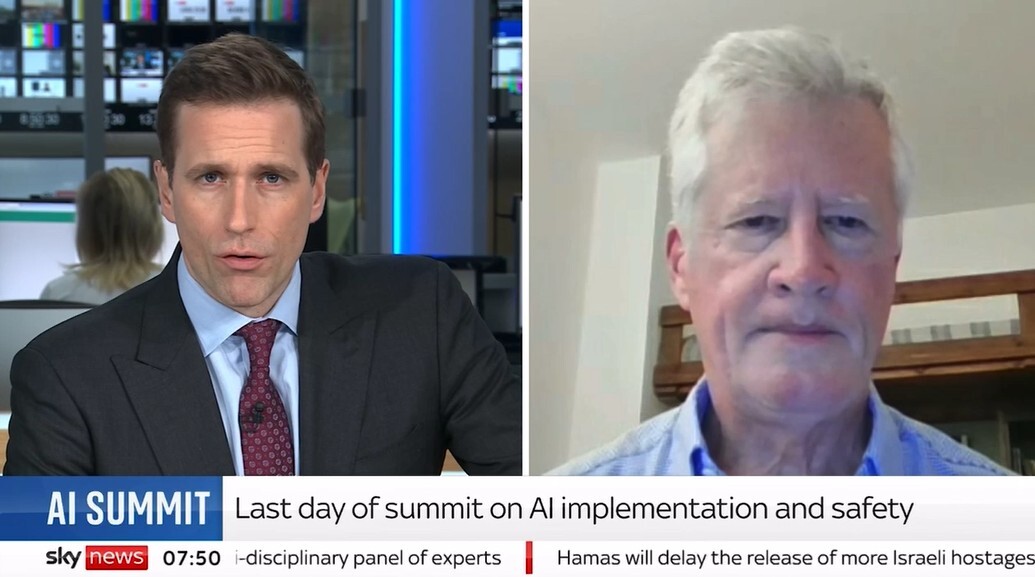
Wilfred Frost had me on Sky News while the AI Action Summit was underway in Paris, to talk about what was actually at stake there: AI risk, and where the UK and Europe stand relative to the US and China on AI development. It's worth setting out my thinking properly here, because a five-minute TV segment never has room for the caveats.
Why Paris marked a shift from Bletchley and Seoul
The Paris summit was the third in the sequence that started with the UK's AI Safety Summit at Bletchley Park in 2023 and continued in Seoul in 2024. Each one has had a different centre of gravity. Bletchley was explicitly about existential and catastrophic risk. Paris reframed the conversation around opportunity and competitiveness, and that shift showed up concretely: the US and the UK both declined to sign the summit's joint declaration on inclusive and sustainable AI. I think that split is the real story of the summit, more than any single announcement made there.
My view on AI risk hasn't softened, even as the framing around me has
I don't think the change in emphasis from safety to opportunity means the risks have gone away, it means governments are increasingly worried about being left behind commercially if they regulate too aggressively while competitors don't. Both things can be true at once: AI development is going to keep accelerating, and the risks I've written about for years, around job displacement, concentration of power, and eventually control of systems more capable than us, are still live. Treating "safety" and "opportunity" as opposites is a mistake I tried to push back on in the interview.
Where the UK and Europe actually stand
Frost pressed me on this directly, and my honest assessment is that the UK and Europe are not setting the pace on frontier AI development, that's concentrated in the US and China, but that doesn't mean there's no role to play. Europe's real leverage is regulatory and diffusion-focused: shaping how AI gets deployed safely across existing industries, rather than trying to out-invest Silicon Valley or Beijing on training the largest frontier models. The UK in particular has genuine strengths in AI safety research that predate this summit cycle, and I think that's a more realistic strategic lane than competing head-on for compute and capital.
Watch the full clip>>