Efficiency
Conscium Neuro AX is creating more efficient AIs, which generate the same output as larger LLMs for smaller inputs of energy, data, and water. We do this using neuro-inspired techniques such as looping and neuro-plasticity, and by restricting models to specific domains.
These two approaches provide four efficiency benefits:
1. Reduced cost by using fewer tokens and less compute
2. Improved speed by requiring fewer operations
3. Improved accuracy because the models adapt as they learn.
4. The models can be deployed in situations which require extreme adaptation - for instance, where they have to adapt to dozens of examples on the fly. This is simply not always possible with standard models.
We’ll explain looping first, and then neuro-plasticity.
Looping models
The conventional approach to improving large language model performance today is based on the so-called scaling laws, which were introduced in a 2020 OpenAI paper by Jared Kaplan. You add more and more parameters, which are analogous to synapses in the human brain, and you use ever-increasing amounts of data and compute to train the model. Unfortunately this requires stupendous investments in chips and data centres, and enormous amounts of energy and data - and we have almost exhausted the finite sources of data.
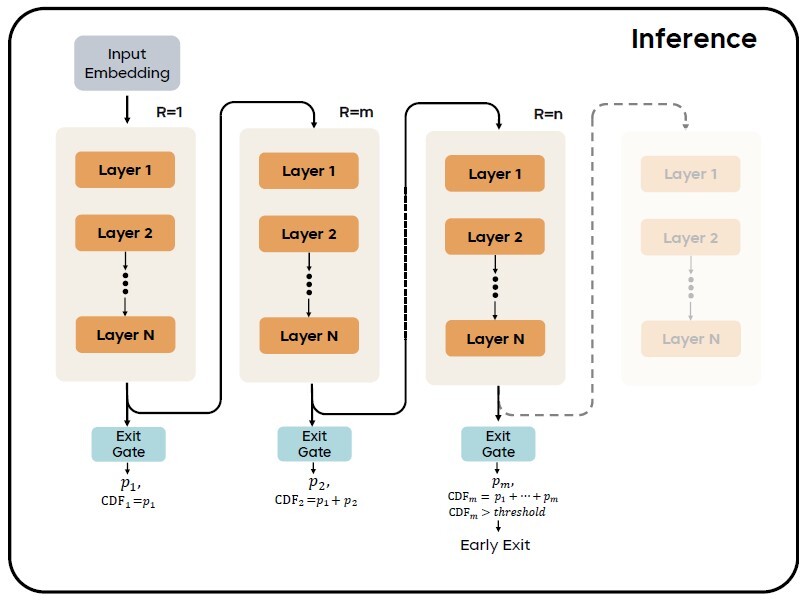
Ouro is an AI language model that exceeds the performance of models up to four times its size, particularly on challenging reasoning and maths tasks. Ouro has 1.4 billion parameters in its smaller version, and 2.6 billion parameters in its larger version. These are modest in comparison with today’s cutting edge models, and Ouro out-performs models with 8 billion parameters.
Ouro is a "looped language model", which is explained in a November 2025 paper called "Scaling latent reasoning by looped language models". It processes input text conventionally, but instead of immediately generating the next token, it pauses at each step to assess its confidence in the output. If it is not sufficiently confident, it loops the computation back to the input.
Only four loops are allowed at each step, and the model is incentivised to minimise the number of loops. The Ouro models are particularly effective with challenging maths benchmarks like GSM-AK.
Looping has been tried before, but has never been effective at scale. Ouro was trained on 7.7 trillion tokens, and performs comparably to models trained on 20 trillion tokens.
Jason Eshraghian, a leading expert in neuromorphic computing techniques, argues that the looped model has neuromorphic characteristics because its recursive and flexible approach emulates the human brain's capacity to adapt how deeply it thinks to the difficulty of a problem. Looped models offer a new scaling dimension: the number of loops. This allows AI engineers to adjust the tradeoff between reasoning and knowledge.
By doing more with less, Ouro shows a way to develop powerful AI models that are accessible to organisations that cannot afford today’s brute-force approach.
The Ouro paper and video caught the attention of the AI research community. There is even speculation that it could turn out to be the Third AI Big Bang, after the arrival of Deep Learning in 2012, and the arrival of Transformer models in 2017.
Neuro-plasticity
In-context learning is one way to achieve neuro-plasticity, a concept from neuroscience, which denotes the brain's ability to rewire itself in response to experience. Connections between neurons strengthen, weaken, or form anew as a person encounters new situations, which is what allows learning to happen throughout life rather than being fixed at birth. A neuro-plastic AI model works in a similar spirit. Rather than baking everything it knows into fixed weights during a vast training run, it adjusts its behaviour on the fly as it meets new examples in its domain.
Neuro-plasticity offers several benefits, including improved learning and memory, and better adaptation to changed circumstances. An example is the way humans learn to recognise categories of things. After seeing just two or three images of an animal they have not seen before, a child can recognise a different image of that animal taken from a different angle. Deep learning systems, by contrast, need to see thousands of images before they can recognise the animal from a new image.
In technical parlance, our in-context learning models are “amortised Bayesian inference engines”. The central idea is that small transformer models are deployed within specific domains, and they are required to learn inference and algorithms rather than data.
A conventional model memorises statistical patterns across enormous datasets. A neuro-plastic model, by contrast, learns a general procedure for solving a class of problems, and when it sees a new case it applies the method rather than searching its memory for something similar. That procedural knowledge is far more compact than a memorised dataset, which partly explains why these models can be small.
In addition, our models perform Bayesian inference. Presented with some information, the model must infer some new information from it. Humans recognising an animal after seeing just a few images is a good example of this. The inference process uses a few images plus basic knowledge about the world to infer how it fits into the mind's model of the world.
Our in-context learning models have three ingredients: an objective function, a collection of scenarios, and an optimiser. The objective function defines what good performance looks like, the scenarios are the range of situations the model is exposed to within its domain, and the optimiser adjusts the model so that it does better across those scenarios over time. The model infers the objective function in the context of a scenario and then applies the optimisation procedure. Because the domain is narrow, the model can afford to specialise deeply rather than spreading its capacity thinly across everything.
The label "amortised Bayesian inference engine" captures the same idea in formal terms. Bayesian inference is the principled way of updating beliefs as evidence arrives. Doing this in detail is usually too expensive to be practical, so instead, the neuro-plastic model learns an approximation that can be reused on every new case. The cost of working out how to reason is incurred up-front and then spread, or amortised, across all the inferences the model later makes.