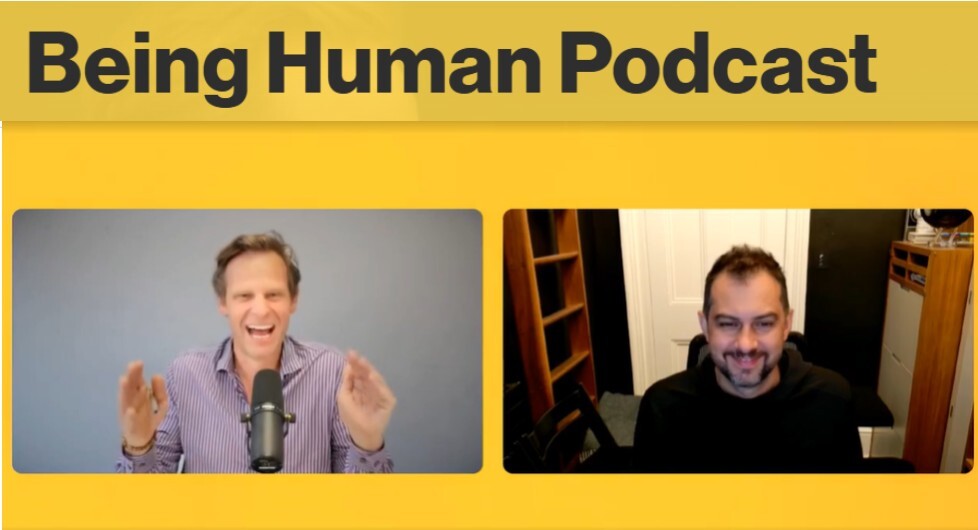
My Conscium co-founder Daniel Hulme spent nearly an hour with Richard Atherton on the Being Human Podcast, and it's one of the more complete public accounts of how he thinks about AI right now, covering the economics of automation, machine consciousness, and what he tells people to teach their kids. I want to pull out the parts I think matter most, partly because I agree with most of it and partly because a couple of points deserve pushing on.
How Daniel got hereRichard opened with Daniel's background, and it's worth restating because it explains why he thinks about AI so differently from most commentators. Daniel founded Satalia, an AI optimisation company, years before generative AI became a mainstream topic, and stayed on as Chief AI Officer after WPP acquired it in 2021. That's practical, commercial AI experience, solving logistics and optimisation problems for real businesses, not theorising from the outside. It's part of why, when Daniel talks about where AI creates economic value, I take it seriously.
The economics: abundance, open source, and what happens to work
A chunk of the conversation covered the economic impact of a technology capable of automating cognitive work at scale, and what an abundance economy built on cheap or open-source AI might look like. This is territory Daniel and I think about constantly at Conscium, and where we mostly agree: the interesting question isn't whether automation displaces jobs in the short term, it's what happens to the structure of the economy if AI keeps getting cheaper and more capable for years on end. Open source plays a real role here, because it changes who can access powerful AI and on what terms, not just which companies win.
Conscious AI, mind crime, and why Daniel takes both seriously
The heart of the episode, for me, is the stretch on conscious AI: what it would mean for a machine to actually be conscious, how we'd know, and what obligations that would create. Daniel went into the "mind crime" problem, the risk that we create suffering in a system capable of experiencing it and fail to notice, either because we don't believe it's possible or because it's inconvenient to believe. This is core Conscium territory, and I think Daniel put it plainly: getting this wrong in either direction, treating a conscious system as a tool, or treating a non-conscious system as though it has feelings, has real costs.
Alignment, empathy, and the "zombie AI" risk
Related to that, Daniel talked through the risks of misaligned AI values and what he calls zombie AI, systems that behave as if they have preferences and goals without anything like inner experience behind them. His argument, which I share, is that empathy might function as a safety mechanism in a way pure rule-following can't. A system that can model what suffering is has a reason to avoid causing it. A system that's just optimising a reward function doesn't, unless we've specified every edge case perfectly, which we won't.
Where AI actually helps a business, and where the hype gets ahead of reality
Richard pushed Daniel on practical business use of AI, where to invest and where to be sceptical, and Daniel didn't just cheerlead. The conversation touched on doubts raised elsewhere about how much genuine reasoning today's models are doing versus sophisticated pattern matching, and on the trend toward AI systems that can behave more like autonomous scientists, generating and testing their own hypotheses. Daniel's practical advice for business leaders, as I understand his position from working alongside him, is to invest in the boring, high-volume, well-defined tasks first, not the flashiest use case.
Creativity, education, and what to tell your kids
The episode closed on something I think about a lot with my own family: what should young people actually be learning right now. Daniel made the case for creativity and critical thinking over rote skills that AI will absorb quickly, and talked about project-based learning as a better model than the standardised curriculum most schools still run. I'd add my own view here, that the specific tools will keep changing, so the more durable skill is knowing how to evaluate an AI's output rather than just how to produce a prompt.
Listen to the full conversation with Daniel on the Being Human Podcast>>