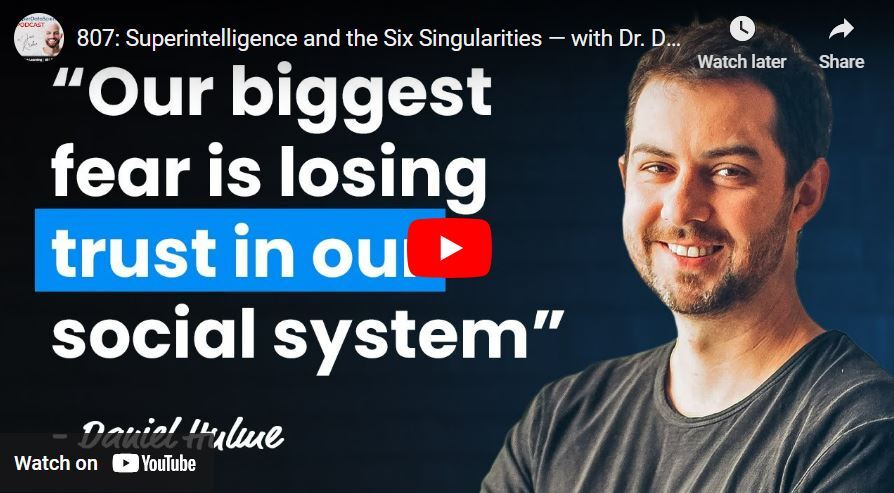
My Conscium co-founder Daniel Hulme spent well over an hour with Jon Krohn on the Super Data Science podcast laying out a framework he's developed that I think deserves wider attention: not one singularity, but six of them, one for each letter of PESTLE, political, environmental, social, technological, legal and economic.
Why one singularity was never the right way to think about this
Most discussion of "the singularity" treats it as a single event, the moment AI surpasses human intelligence, full stop. Daniel's framework splits that into six separate transition points, one per domain, because the political consequences of transformative AI, upheaval in how power and trust work, aren't the same shape as the economic consequences, or the environmental ones. I think this is a genuinely useful corrective to how loosely the term singularity gets thrown around in both AI hype and AI panic.
The environmental case: a binary outcome, not a spectrum
The framing Daniel used for the environmental singularity is stark: either we lose control of our ecosystem, or we gain control over it, and AI is the deciding factor in which way that goes. Applied to problems like energy use and climate systems, he argues AI could meaningfully cut the energy required to run the planet's infrastructure. I share his view that this is one of the more underrated upside cases for AI, it gets far less attention than jobs or safety, but the stakes are arguably just as high.
Regulate, don't prevent
Daniel's response to AI skeptics on the podcast was to point at a technology we've already learned to live with: financial markets. Stock markets are volatile, unpredictable, and technologically mediated at every level, and society's answer wasn't to ban them, it was to regulate them. He applies the same logic to AI, arguing the benefits are large enough that the right response is building proper regulatory guardrails, not trying to hold the technology back.
Machine consciousness and the capacity to suffer
This is the part of the conversation closest to home for us at Conscium. Daniel talked through how thinking about consciousness in living systems might need to extend to non-living ones too, and what follows from that: if something can be said to be conscious, the question of whether it can suffer isn't far behind. He also touched on wanting AI systems to develop something like inherent curiosity, which ties directly into the deeper research questions Conscium was built to investigate.
The parts worth listening to directly
Jon and Daniel also got into the case for decentralising technology, what a future where AI enhances rather than replaces human creativity at work might look like, and Daniel's own academic background modelling bumblebee brains during his PhD, which is a better explanation than most for why he thinks about intelligence, artificial or otherwise, so differently from people who came into AI through computer science alone.
Listen to the full episode on the Super Data Science podcast.