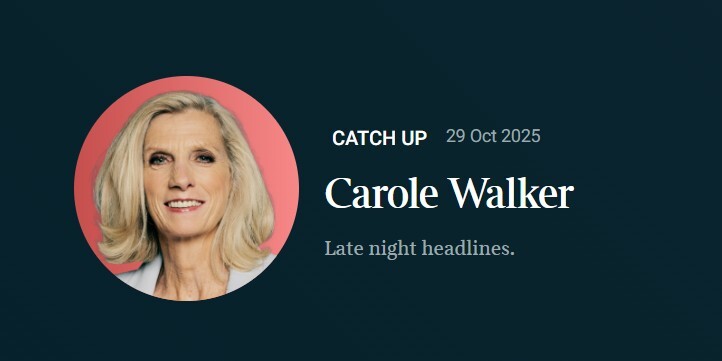
I went on Times Radio this week to talk about Amazon's latest round of job cuts, and whether it marks the start of the AI jobpocalypse everyone keeps asking me about. My short answer, given live to Carol Walker alongside Ali Sarrafi, co-founder and CEO of the enterprise AI agent platform Kovant, is no. Not yet. What's happening at Amazon right now is not what large-scale AI automation looks like.
Amazon isn't cutting jobs because AI is doing them
Amazon becoming the latest big company to shrink its workforce was the news hook for the segment, and UPS cutting around 48,000 jobs since last year came up too. My view is that both cases get misread. Amazon's cloud arm, AWS, has been losing ground to competitors, and like every other hyperscaler it's pouring enormous sums into data centres and AI infrastructure. That's what this round of cuts is actually about. It isn't evidence that AI agents have quietly taken over Amazon's warehouses or back office. Ali made a related point I think is underrated: businesses that are already struggling sometimes use AI as the headline reason for layoffs that were coming anyway, which muddies the public picture of what AI can and can't do right now.
Why I think we're both overestimating and underestimating AI's effect on jobs
I said something on air that I want to spell out properly here: we're overestimating the short-term jobs impact and underestimating the long-term one. In the near term, people will need to retrain and switch roles faster than before, but the pattern will look like previous technology shifts, more churn, not mass unemployment. Ali drew the comparison to the internet creating jobs nobody could have predicted, Uber drivers being the obvious example. I don't disagree with that as a description of the next few years. Where I part ways with a lot of commentary is further out. At some point, and I couldn't tell you if that's five years or twenty, I think we stop having jobs for humans to do at all, because the software will do them cheaper, faster and better. That's a much bigger claim than "some jobs will change," and it's the one I think deserves more airtime than it gets.
What AI agents actually are, and why everyone in AI is obsessed with them
A chunk of the interview was about AI agents, because that's what the AI industry is fixated on at the moment. An agent isn't just a chatbot that retrieves information or writes you a poem in the voice of Shakespeare. It can act. It can carry out multi-step tasks in the real world with only modest human supervision. They're not that capable yet, but the trajectory is steep, and you can already try one yourself, in ChatGPT, hit the plus icon in the query box and you'll find the option to spin up an agent. I mentioned an example on air: the boss of a small agency who has his AI agent turn research briefings into a seven-minute podcast he listens to on the way into work. That's a real behaviour change happening now, not a future scenario.
The odd part: small companies are getting more out of AI than large ones
One point I made that I think is properly counterintuitive is this: right now, small companies are seeing more productivity benefit from large language models than large companies are. If you're small and an LLM produces a report with a few errors in it, you catch the mistakes and move on, it's not mission-critical. A large business can't take that risk in the same way, so its AI adoption gets slower and more cautious even though it has more resources to throw at the problem. Scale, for once, is a disadvantage.
Is this an AI bubble? My answer is still no, but the circularity question is fair
Ali asked me directly whether the numbers involved, Nvidia becoming the first company with a $5 trillion market value, twelve zeros, are a sign the whole thing is overheating. I don't think it's a bubble in the dot-com sense, because this spending, roughly ten times the cost of the Apollo programme, is being funded by revenue rather than debt. Carol pushed back on the circularity in the system: Nvidia invests in OpenAI, OpenAI uses that money to buy Nvidia chips. I agreed that circularity like that is often a symptom of late-bubble economics, and it's worth watching. But even if this bubble does eventually pop the way the dot-com one did, I don't expect it to trigger anything like 2008. Some assets would lose value and some people would take a loss, but the businesses behind this spending have real revenue behind them, unlike the pets.com era. Ali made the same point from a different angle: there's real enterprise demand driving this, not speculation with no business behind it.
Where I think AI can genuinely help: government and small business
Carol closed by asking about Jeremy Hunt's piece in the Times, arguing AI could help government cut costs and boost public sector productivity, which lags a long way behind the private sector. I think there's real scope there, especially for the parts of government work that involve tasks nobody particularly wants to do. Ali extended that argument further than I did, making the case that AI will help level the playing field for smaller companies competing against bigger incumbents, and for smaller economies competing against larger ones. I think that's right, and it's a more optimistic note than the "jobpocalypse" framing the segment was built around.
Watch the full segment on Times Radio>>