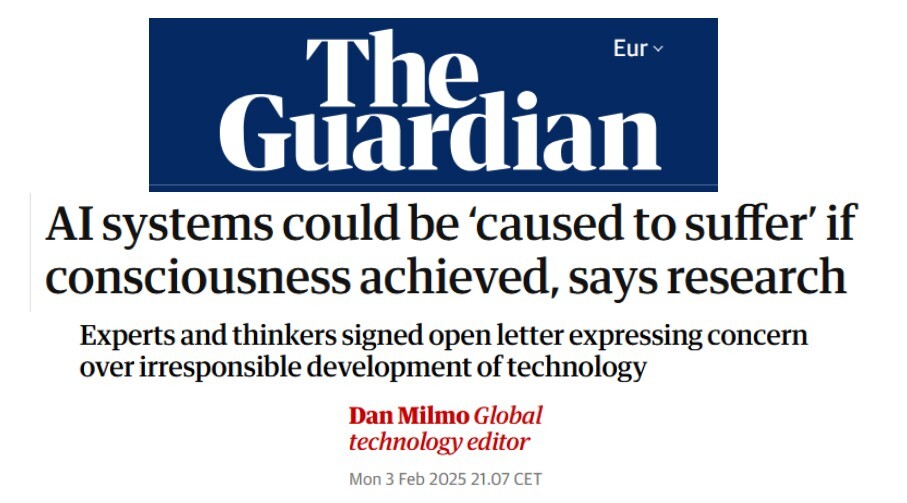
The Guardian covered the open letter we organised at Conscium on how to research AI consciousness responsibly, in a piece by Dan Milmo headlined around the risk that a conscious AI system could be "caused to suffer" if we get this wrong. Over a hundred experts and practitioners signed it, including Stephen Fry, and I think the coverage captured the core problem fairly: we might be closer to building something that can suffer than most people realise, and almost nobody is planning for that responsibly.
What the letter actually asks for
The letter sets out five principles rather than a single demand, because there isn't yet consensus on what conscious AI would even look like. In short: prioritise research into understanding and assessing consciousness in AI systems before we build them at scale, put real constraints on developing systems that might be conscious, take a phased rather than a rush approach, publish findings openly rather than keeping them proprietary, and stop making overconfident public claims, in either direction, about whether a system is or isn't conscious. That last one matters to me particularly, because both overclaiming and dismissing the question outright cause real damage.
The research behind it
The letter sits alongside a peer-reviewed paper by Patrick Butlin at Oxford and Theodoros Lappas at the Athens University of Economics and Business, published in the Journal of Artificial Intelligence Research. Their argument, which the Guardian summarised well, is that systems which are conscious, or which convincingly appear to be, could exist soon, and that if a powerful AI system could reproduce itself, we could suddenly be dealing with large numbers of new entities that deserve moral consideration. They also make a point I don't think gets enough attention: even a company with no intention of building a conscious system needs a plan for what happens if it creates one by accident.
Why this isn't just a philosophy problem
The paper asks what follows if an AI system qualifies as what philosophers call a moral patient, an entity that matters for its own sake rather than for its usefulness to us. Would switching one off be closer to turning off a laptop or closer to something more serious. I don't think we have to answer that today, but the letter's point, and mine, is that we need a research and governance process in place before the question becomes urgent rather than after.
Signatories from inside the industry, not just outside critics
One detail worth drawing out is who signed. This wasn't a letter from outside critics of AI, it included AI professionals working inside companies like Amazon and WPP, alongside academics such as Sir Anthony Finkelstein. That matters because it shows this concern isn't confined to people with no stake in AI's success. It's shared by people building the technology.
Read the full article on The Guardian>>
The Guardian on Conscium's Open Letter
Calum Chace