
Quick Summary
Langfuse alternatives address gaps or limitations teams encounter with Langfuse’s strong open-source observability platform. If you’re after independent, pre-deployment AI agent verification, VerifyAX leads this list with third-party testing and auditable results. LangSmith and Arize Phoenix are the strongest picks for production observability.
|
Tool |
Best For |
Starting Price |
Free Offer |
|
VerifyAX |
Independent AI agent testing and verification |
PAYG and custom |
Free trial (500 credits) |
|
LangSmith |
AI teams needing agent observability, tracing, and debugging |
$39 per seat/month |
Free plan (5000 traces per month) |
|
Arize Phoenix |
Open-source observability with managed cloud option |
$50/month |
Free tiers |
Why Teams Outgrow Langfuse
Over 100,000 engineers use Langfuse to trace and evaluate their LLM applications; it is well-built, open source, and widely adopted. But as AI teams move from development to production, their requirements can extend beyond observability and evaluation, and certain gaps can become hard to ignore.
For enterprise teams that want another layer of confidence in their production AI agents, these 10 Langfuse alternatives offer deep observability, evaluation, built-in validation, and independent testing.
But first, let’s look at what Langfuse does and why another tool may be a better fit.
Why Listen to Us?
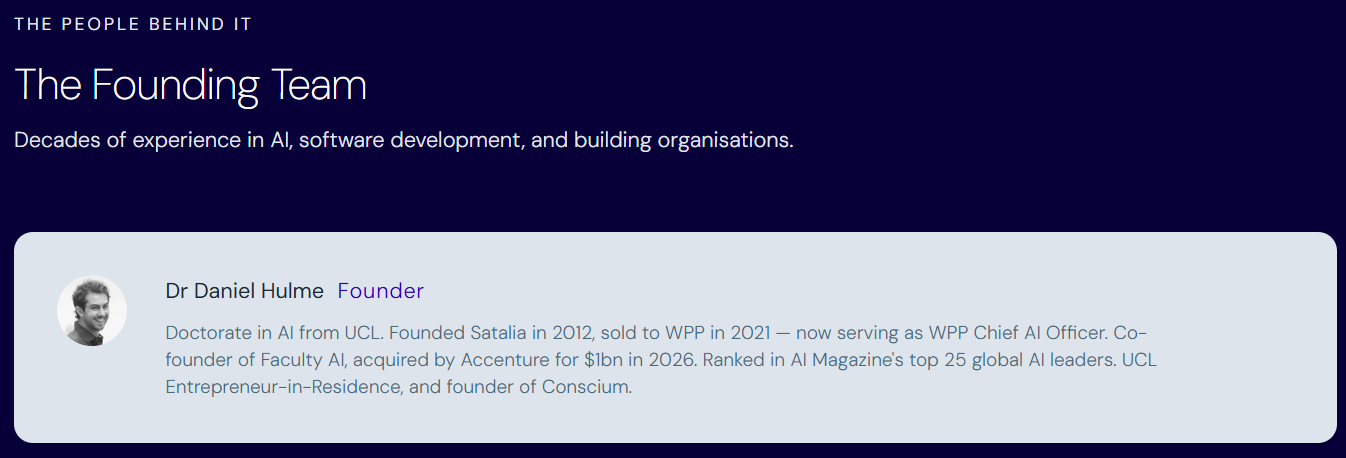
Daniel Hulme, founder and CEO of Conscium, studied AI long before it was fashionable and is ranked among the top 100 global AI leaders. He serves as Chief AI Officer at WPP and built Satalia, an AI consultancy company that WPP later acquired.
We built VerifyAX because we kept seeing organisations build agents without an independent way to assess how they would behave in the real world. When teams can’t deploy with confidence, they may stall, deploy less autonomous agents than planned, or deploy internally with little governance.
Why Look for Langfuse Alternatives?
The free tier runs out fast
Langfuse’s Hobby plan gives you 50,000 units per month, 30-day data access, and two users. Agents that handle production traffic will use that up quickly. Additional usage on paid plans starts at $8 per 100k units, which adds up as traffic grows.
Enterprise controls sit behind a paywall
SOC 2 and ISO 27001 compliance reports start on Pro at $199 per month. If your organisation’s got regulatory requirements, you’ll have to pay that premium before your first agent ships.
It watches production but doesn’t test before it
Langfuse watches and tells you what your AI agent does once it’s already running. The platform doesn’t simulate thousands of real-life scenarios to tell you what they will do after you deploy.
If you want to catch failures before your agent reaches a real user, you’ll need a different kind of tool. And getting pre-deployment testing from an independent third party means looking beyond observability entirely.
10 Best Langfuse Alternatives
1. VerifyAX
2. LangSmith
3. Arize Phoenix
4. Braintrust
5. Maxim AI
6. LangWatch
7. Galileo
8. Patronus AI
9. Confident AI
10. Helicone
|
Tool |
Best For |
Starting Price |
Free Offer |
|
VerifyAX |
Independent pre-deployment agent verification for enterprise teams |
PAYG and Custom pricing |
Free trial (500 credits) |
|
LangSmith |
Production tracing with LangChain integration |
$39 per seat/month |
Free Developer plan. |
|
Arize Phoenix |
Open-source observability with managed cloud |
$50/month |
Free tiers |
|
Braintrust |
Building eval datasets & testing prompts or models with unlimited seats |
$249/month |
Free Starter tier |
|
Maxim AI |
End-to-end evaluation, production monitoring and prompt management |
$29/seat/month |
Free Developer plan |
|
LangWatch |
Agent simulation, CI/CD & production evaluations with low-cost event pricing |
€29/core seat/month |
Free Developer plan |
|
Galileo |
Evaluation and guardrails (now part of Cisco) |
$100/month (billed annually) |
Free plan |
|
Patronus AI |
Enterprise simulation infrastructure |
Custom pricing |
None listed |
|
Confident AI |
Open-source eval (DeepEval) with optional cloud |
$200/month |
Free plan |
|
Helicone |
Lightweight request logging and cost tracking |
$79/month |
Free Hobby plan |
1. VerifyAX
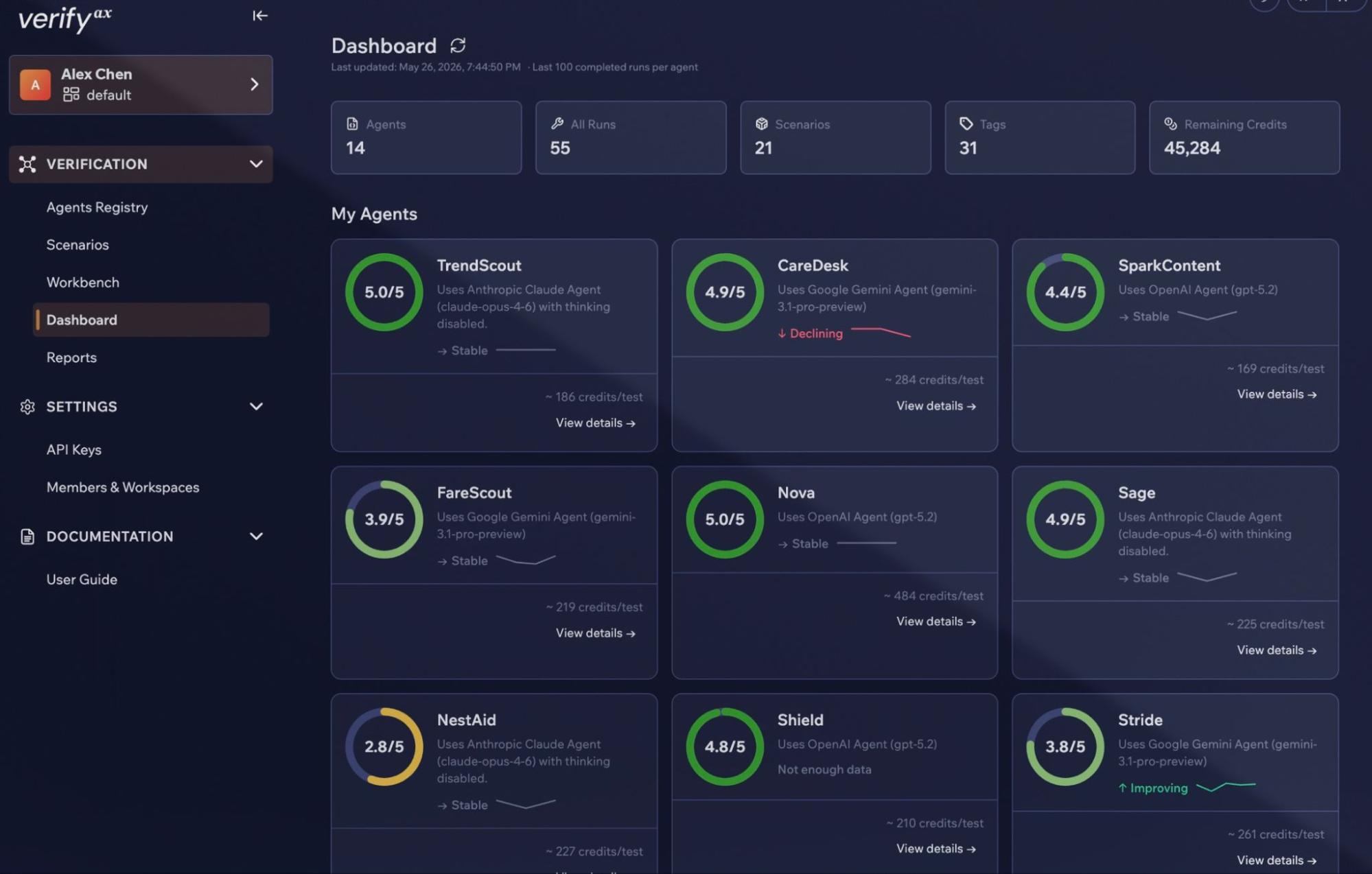
VerifyAX is an AI agent verification platform that’s built for enterprise teams who need to verify how their AI agents will work before they deploy. Does the agent do its job correctly? Is it reliable in edge cases and failure conditions?
Think of it like a driving test. You wouldn’t let someone on the road after a written exam alone. You shouldn’t deploy an agent based on a few benchmarks in a notebook either.
We put your AI agents through functional and non-functional testing, plus simulation tests across realistic scenarios. We score every run on truthfulness, correctness, robustness, efficiency, and adaptability. You also get an audit-grade report with full transcripts, explanations, and recommendations after each test.
What sets VerifyAX apart from most tools on this list is independence, which is an important distinction for governance. We’re a third party; we don’t build or host your AI agents.
Key Features
- Benchmark Testing: Tests agents against structured inputs at scale, including text, images, tables, and common file formats, with synthetic data generation for stress-testing
- Multi-Agent Simulation: Deploy synthetic agents with distinct personalities to act as collaborators, stakeholders, or adversaries and test complex interactions
- Tool & Workflow Evaluation: Measure how your agent uses enterprise tools like email, Jira, and Slack, scoring workflow completion, output correctness, and consistency
- Evidence-Backed Scoring: Scores every test and backs each result with transcripts, findings, and explanations
- Audit-Grade Reporting: Get full transcripts, written explanations, and improvement recommendations after every verification run
- Governance Dashboard: Track agent performance, pass rates, spending, and compliance across your entire AI portfolio
- Continuous Re-Verification: Set alerts for when agents need retesting after updates or model changes
Pricing
Free self-serve trial with 500 credits and no credit card requirement. Developer plan is pay-as-you-go; Enterprise and Partner plans are quoted on request.
Pros
- Independent third-party verification with audit and compliance reporting
- Pre-deployment simulation testing with ongoing verification in production
- Supports agent, model, and tool integration through API or A2A
- Model agnostic; your verification won’t change if you switch providers
- Cost-effective and easy to start
Cons
- Early-stage platform that’s still maturing
Best For: Enterprise teams in regulated industries that need independent, pre-deployment verification of AI agent behaviour.
2. LangSmith
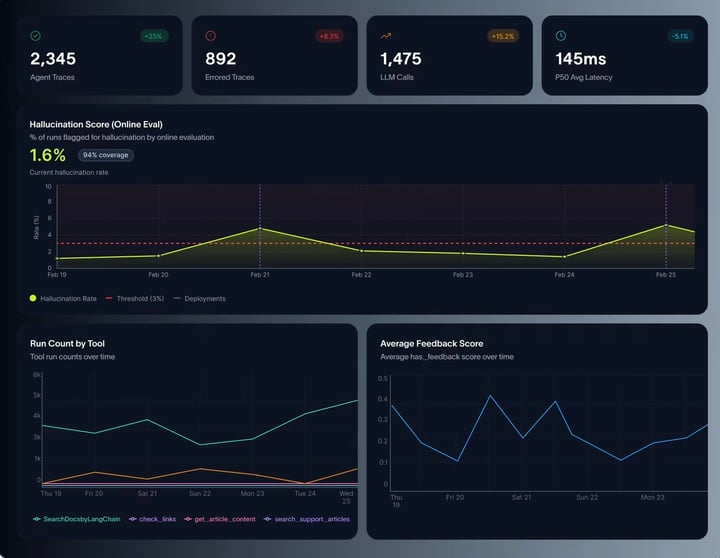
LangSmith is LangChain’s observability and evaluation platform. It traces every step your agent takes in production, from LLM calls to tool invocations. You’ll get real-time dashboards for latency, cost, and error rates. LangSmith supports popular agent frameworks and works with any agent stack through its Python, TypeScript, Go, and Java SDKs.
Key Features
- Step-by-Step Tracing: See exactly what your agent did at each stage, with full conversation threading
- Online and Offline Evaluation: Supports evaluations across AI applications and traces, including LLM-as-a-judge evaluators and human feedback
- Automatic Clustering: Detect usage patterns and failure modes without writing manual rules
- SmithDB: Query millions of traces in sub-second time using a database built for agent observability
Pricing
There’s a free Developer plan with 5,000 base traces per month and one seat; Plus plan costs $39/seat/month with 10,000 base traces; Enterprise pricing is custom; and additional usage is billed on a pay-as-you-go basis.
Pros
- Deep native integration with the LangChain ecosystem
- Transparent seat pricing with free trace allowances
- Self-hosting and BYOC options for data residency
Cons
- Per-seat costs can pile up quickly for larger teams
- It’s most valuable if you’re already using LangChain
Best For: AI teams needing agent observability, tracing, and debugging.
3. Arize Phoenix
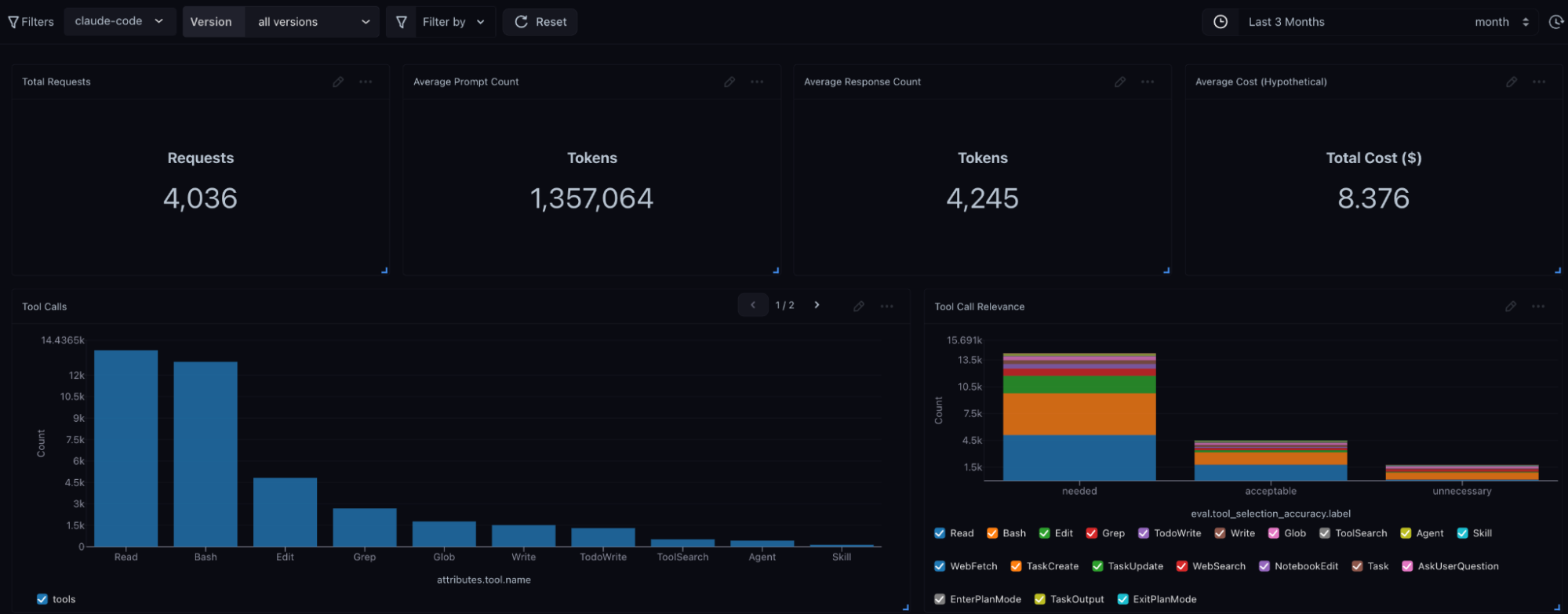
Arize Phoenix is an open-source, local-first observability platform for tracing, evaluation, experimentation, and prompt iteration. It can run locally or be self-hosted, while Arize AX provides managed observability and evaluation for teams that need a production platform. Key features
- Open-Source Core: Runs locally or self-hosted under the Elastic License 2.0 (ELv2), with no feature gates or usage caps
- Multi-Modal Tracing: Traces multimodal agent workflows, including text, images, and voice data, with support for multimodal evaluation across image, voice, and PDF workloads
- Unlimited Evaluations: Runs unlimited online and offline evaluations, experiments, and datasets on Arize’s hosted tiers, without per-evaluation charges
- AX Cloud: Provides managed observability and evaluation with AX Free at $0 for 25,000 spans per month, and AX Pro from $50 per month for 50,000 spans
Pricing
Phoenix OSS is free to self-host; AX Free plan costs $0 for 25,000 spans per month; AX Pro costs $50/month and includes 50,000 spans; AX Enterprise has custom pricing.
Pros
- Open-source Phoenix with no feature or usage limits
- Low-cost entry points for managed cloud observability
- Strong multi-modal support for voice and image agents
Cons
- Self-hosting requires infrastructure management
- Limited data retention on Free and Pro tiers
Best For: AI teams needing open-source control over tracing and evaluation.
4. Braintrust
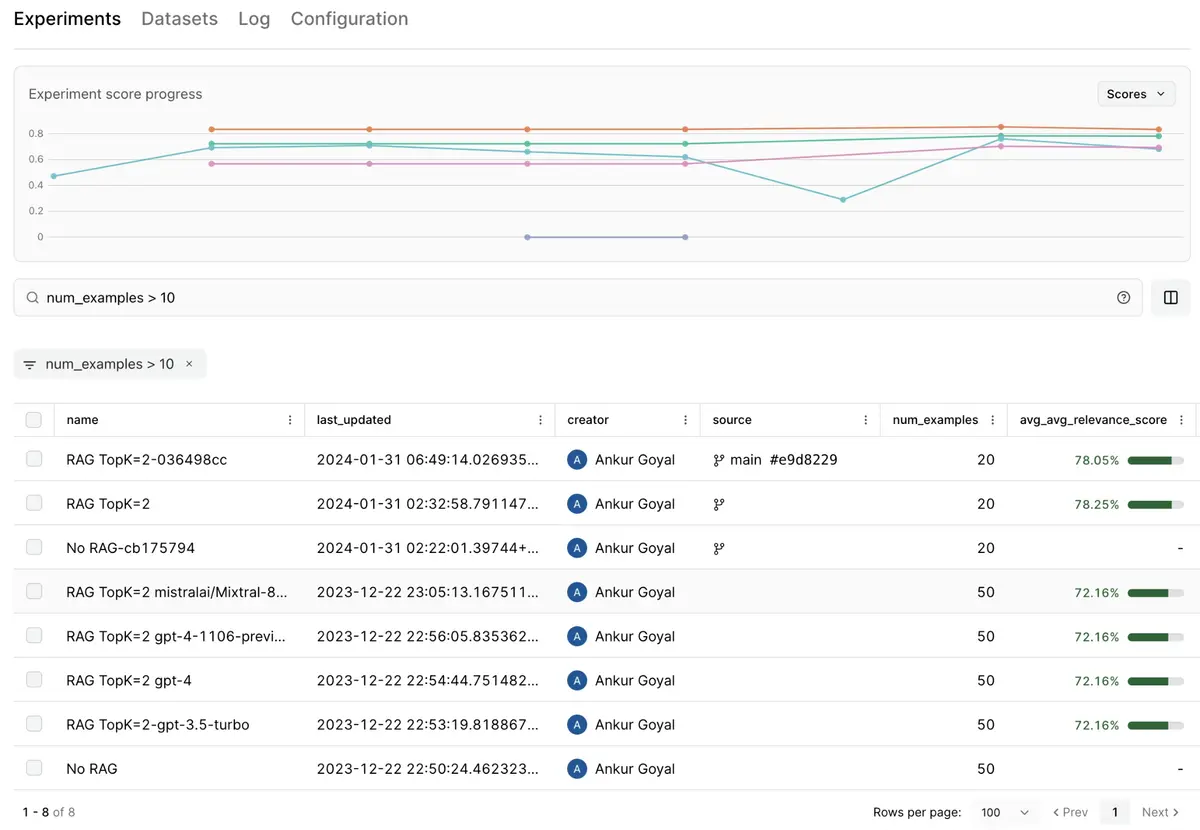
Braintrust is an agent observability and evaluation platform that helps teams inspect production behavior, turn patterns into evals, and improve agent quality with every release. Its platform combines observability, evaluations, and production behavior discovery in one workflow.
Key Features
- Unlimited Users: Every tier supports unlimited seats, projects, datasets, playgrounds, and experiments
- Eval-First Design: Builds evaluation datasets, runs experiments, and scores outputs with LLMs, code, or human reviewers
- Usage-Based Pricing: Charges for processed data and scores without per-seat fees, alongside a fixed platform fee on Pro
- Production Discovery: Finds production failures and turns them into regression datasets and evaluators
Pricing
It restructured pricing in March 2026 to charge only for usage. Every plan has unlimited users, including the free tier:
- Starter: Free (1 GB data, 10,000 scores, 14-day retention)
- Pro: $249 per month (5 GB, 50,000 scores, 30-day retention)
- Enterprise: Custom pricing
- Startup Programme: 6–12 months of free Pro for qualifying startups
Pros
- No per-seat pricing keeps cost predictable as your team grows
- Strong evaluation and experiment tooling.
- Generous startup programme for early-stage companies
Cons
- Capped data retention on Starter limits post-incident debugging
- Steep jump from free to $249 per month
Best For: AI-native teams that want evaluation at the centre of their workflow without per-seat costs.
5. Maxim AI
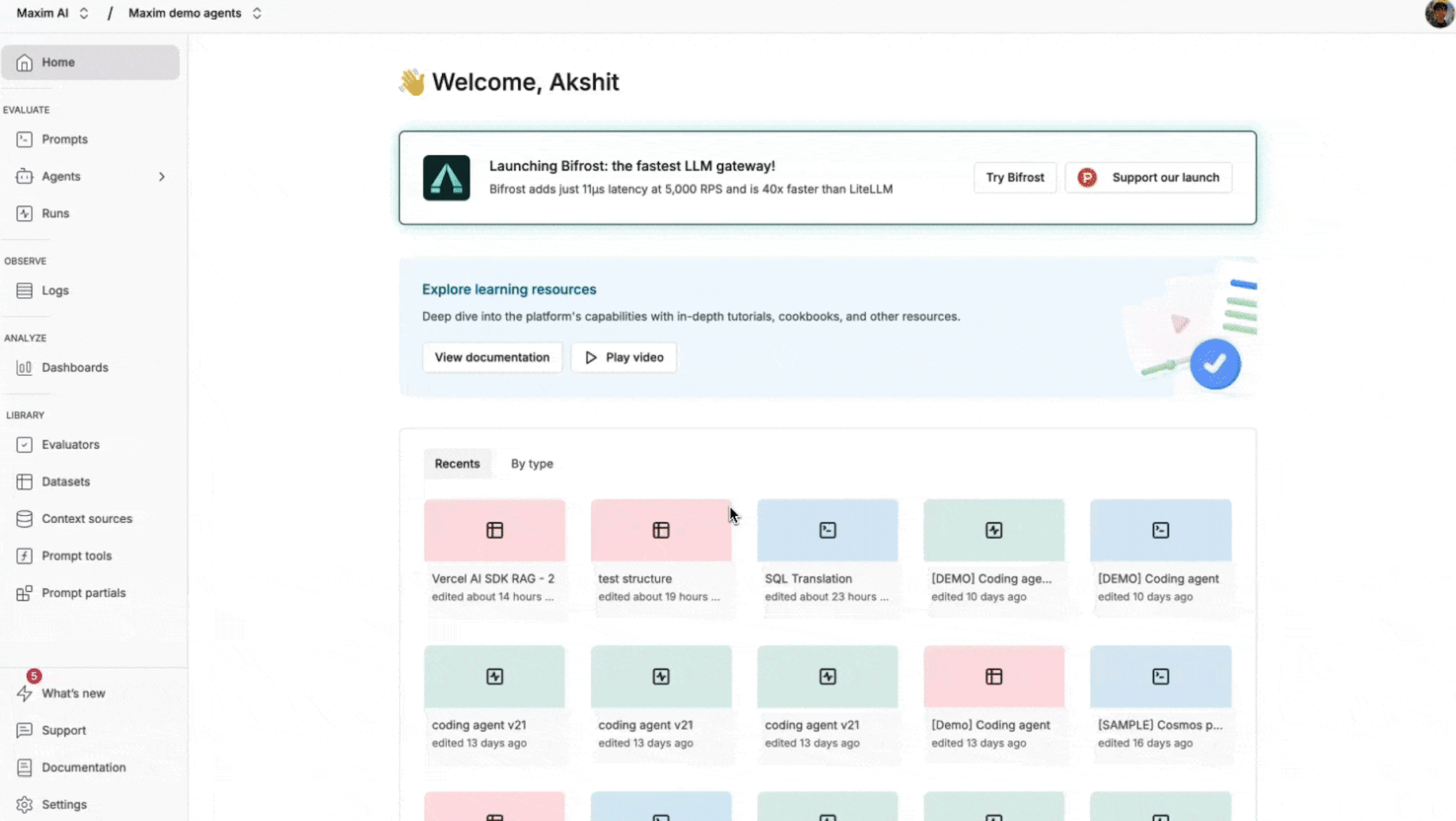 Maxim AI covers the full lifecycle from prompt engineering to production monitoring. Its Playground++ supports prompt experimentation and versioning, while its evaluation and observability tools help teams test agents, monitor production quality, and continuously improve datasets. It’s one of the few tools here that closes the loop between prompts, evals, and monitoring.
Key Features
- Prompt Playground: Enables teams to experiment with prompts, compare outputs, version prompts, and deploy them from one interface
- Data Engine: Generates synthetic data, imports and curates production data, supports labeling and enrichment, and creates targeted dataset splits for evaluation
- Agent Observability: Tracks production traces, monitors interactions, runs evaluations, supports human annotation, and alerts teams to quality regressions
- Agent Simulation and Evaluations: Tests agents across scenarios using AI-powered simulations, predefined or custom metrics, large test suites, and human evaluations
Pricing
Offers a free Developer plan with up to three seats and 10,000 logs per month. Professional costs $29 per seat with 100,000 logs per month; Business costs $49 per seat with 500,000 logs per month; Enterprise has custom pricing.
Pros
- Low entry price with a free tier that includes three seats
- Covers prompt management, evaluation, and monitoring in one platform
- Multimodal support for text and image datasets
Cons
- Per-seat pricing means costs grow with team size
- Breadth of features can feel overwhelming if you’re on a smaller team
Best For: Teams that want prompt management, agent evaluation, and production monitoring in a single platform.
6. LangWatch
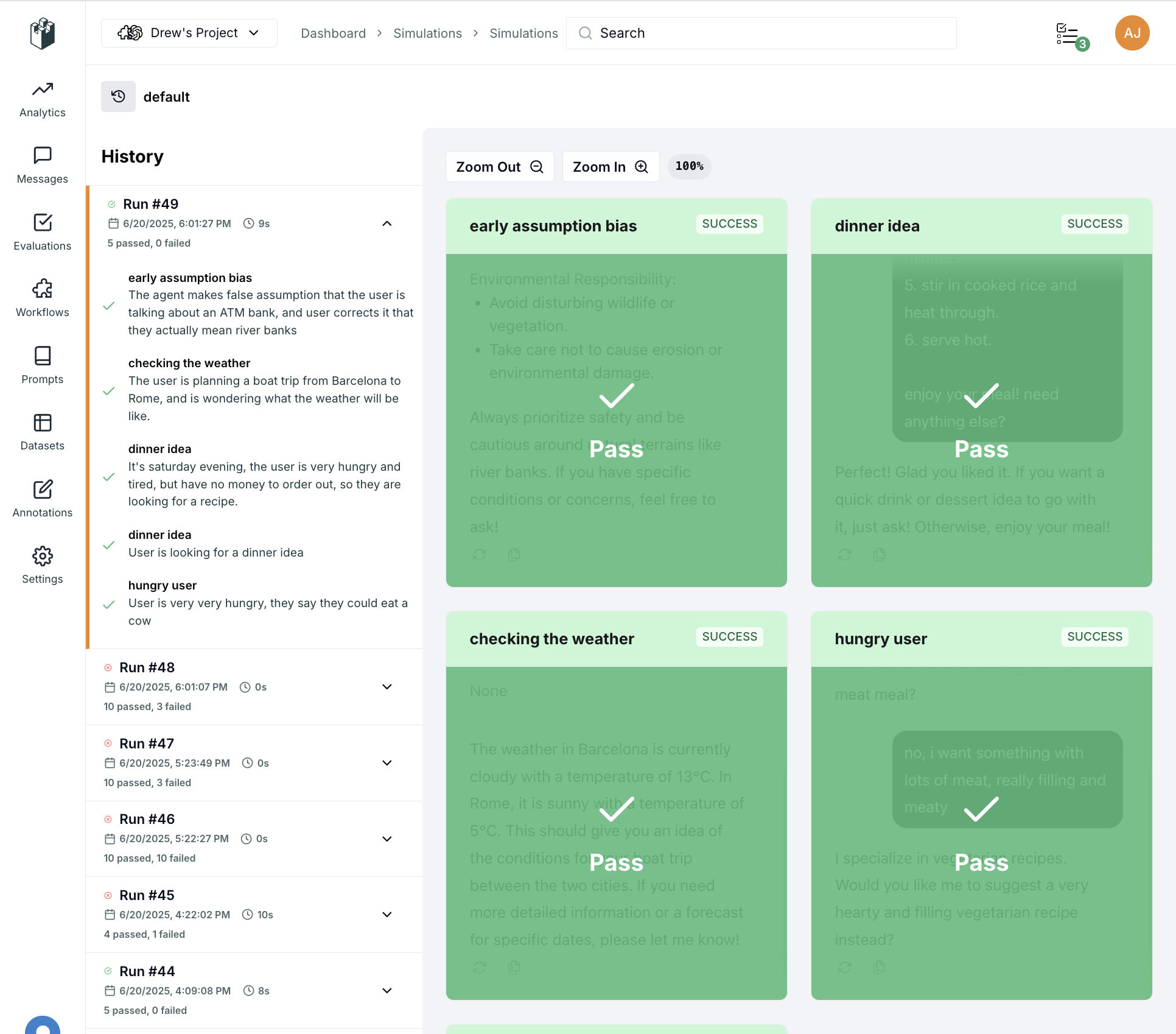
LangWatch combines observability, evaluations, and agent simulations into one platform for testing and monitoring AI agents. It supports both text and voice simulations, lets teams run evaluations in CI/CD and production, and provides tracing, prompt management, and dataset tools for the agent development lifecycle. LangWatch is also open source under the Apache 2.0 license.
Key Features
- Agent Simulations: Tests AI agents through multi-turn conversations, tool calls, and configurable success criteria
- Voice Testing: Simulates voice agents with latency, interruptions, and background-noise testing
- Observability: Monitors agent traces, sessions, token usage, costs, topics, and multimodal data in production
- Evaluations: Assesses agent outputs and conversations using LLM judges, custom evaluators, built-in metrics, and human feedback
Pricing
LangWatch charges per core seat plus event usage. Developer is free with 50,000 events and two users per month; Growth costs €29 per core seat per month with 200,000 events; Enterprise pricing is custom
Pros
- Open-source platform under Apache 2.0 with self-hosting
- Text and voice agent testing with multi-turn simulations
- Event-based pricing keeps costs predictable as usage grows
Cons
- Smaller community compared to LangSmith or Langfuse
- There’s only 30-day retention on Growth unless you pay for extension
Best For: AI teams building text and voice agents that want simulation testing on a budget.
7. Galileo
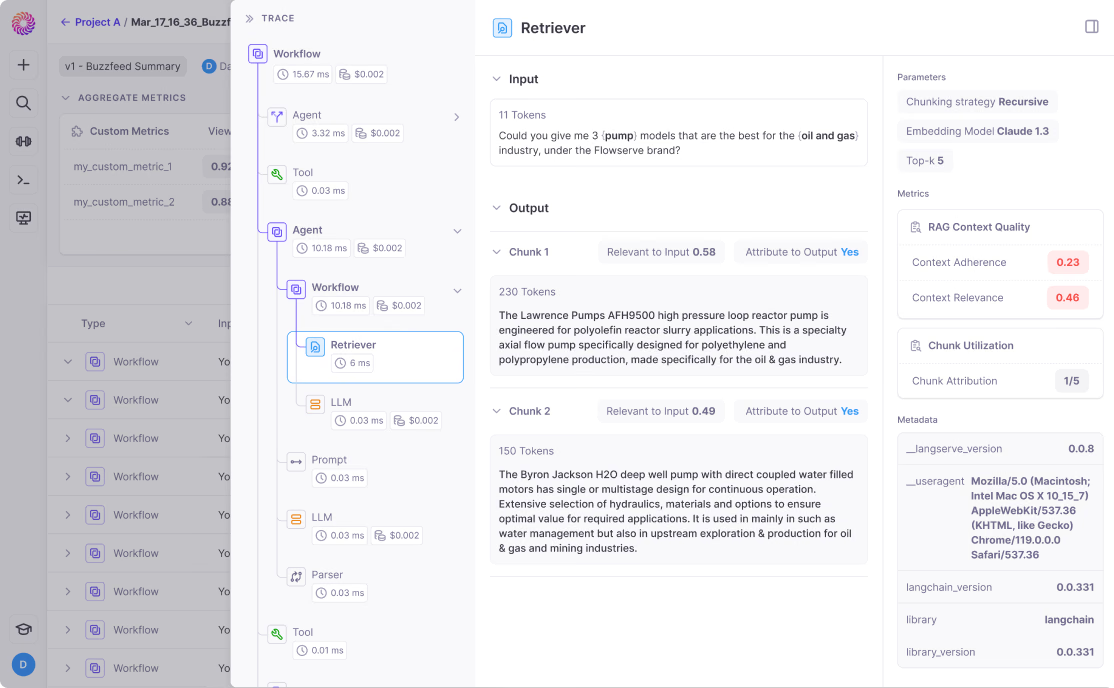
Galileo combines tracing, custom evaluations, failure analysis, and real-time guardrails with deployment options spanning SaaS, VPC, and on-premises environments. Cisco completed its acquisition of Galileo in May 2026, so the product is now offered as Splunk Agent Observability.
Key Features
- Custom Evaluations: Build and run unlimited custom metrics and offers 20+ built-in evaluations for RAG, agents, safety, and security
- Real-Time Guardrails: Applies evaluation-based policies to control agent actions, tool access, and escalation in production
- Luna Models: Uses smaller optimized models for lower-cost, low-latency LLM-as-a-judge evaluations on production traffic
- Agent Observability: Analyzes traces, prompts, models, functions, context, datasets, and MCP servers to identify failures
Pricing
Galileo offers a free plan at $0/month with 5,000 traces; Pro costs $100/month (billed yearly) and includes 50,000 traces; Enterprise pricing is custom.
Pros
- Cisco backing brings enterprise credibility and stability
- SaaS, VPC, and on-premises deployment options
- Generous free tier with unlimited users and evaluations
Cons
- Roadmap’s now inside Cisco, and that could slow feature development
- Trace-based pricing can get expensive at high volume
Best For: Enterprise teams that value major-vendor stability and want evaluation, observability, and guardrails in one platform.
8. Patronus AI
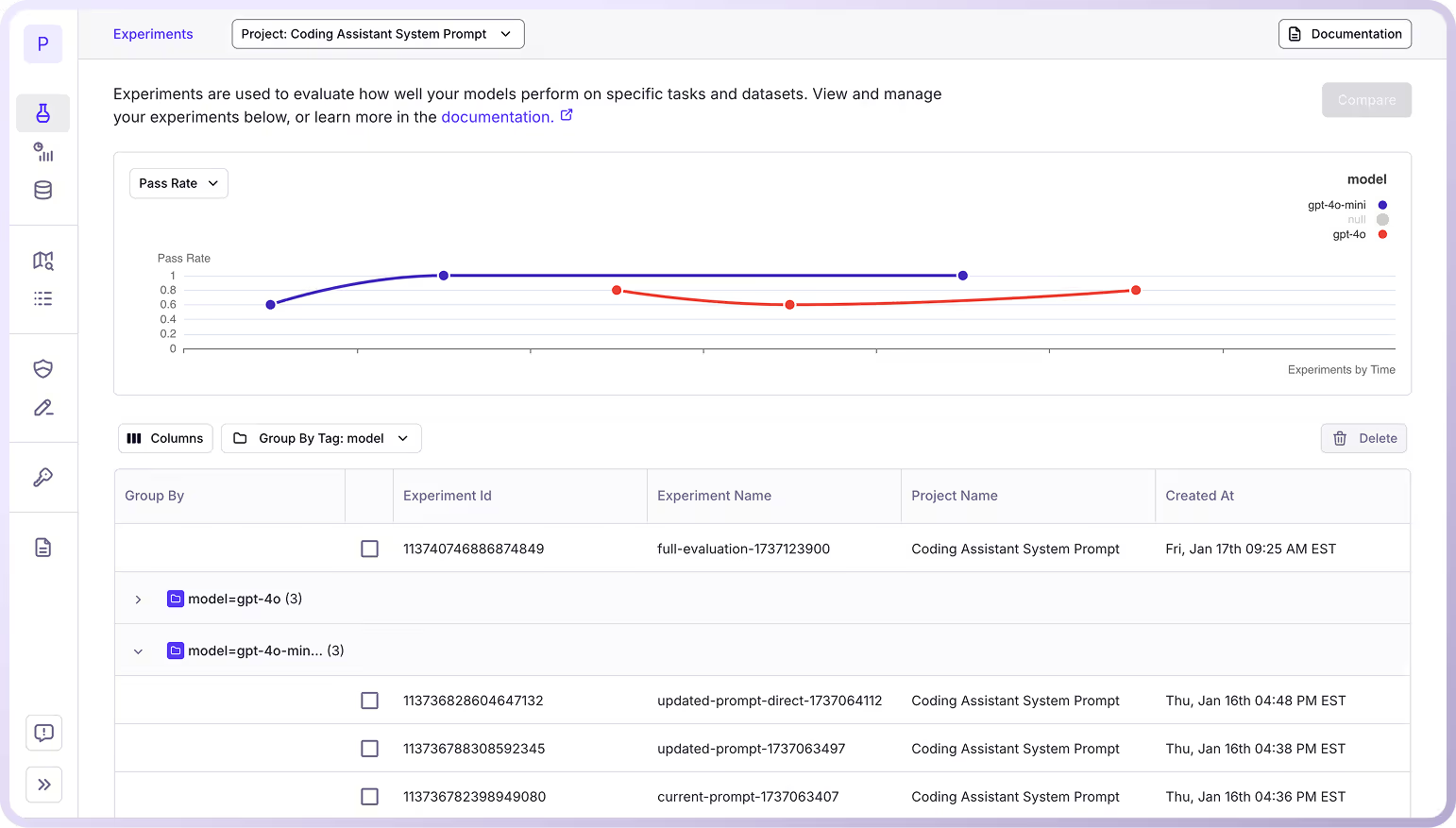
Patronus AI is a frontier research lab. Its Digital World Models are interactive simulated environments where AI agents can train and operate across realistic digital workflows, including software development, customer service, finance, and product applications. The lab’s published research includes Lynx for hallucination detection and GLIDER for explainable evaluation.
Key Features
- Digital World Models: Build interactive simulations with high fidelity to live product environments
- Lynx: Use a hallucination detection model with strong published benchmark performance
- Long-Horizon Simulation: Tests AI agents on tasks spanning days to months, including planning, deep research, multi-turn dialogue, and memory.
- Expert Network: Leverages 5,000+ experts across software, academia, finance, and other fields to support simulations and research.
Pricing
Patronus AI doesn’t publish pricing. Plans are custom and quoted per engagement.
Pros
- Deep research pedigree with published models and benchmarks
- Simulation environments go beyond simple eval to full behavioural testing
- Documented enterprise customers including MongoDB and Etsy
Cons
- There’s no public pricing, so budgeting’s hard without a sales call
- It’s a research-focused platform that may be more than smaller teams need
Best For: Enterprise teams that need research-grade simulation for complex AI agent workflows.
9. Confident AI
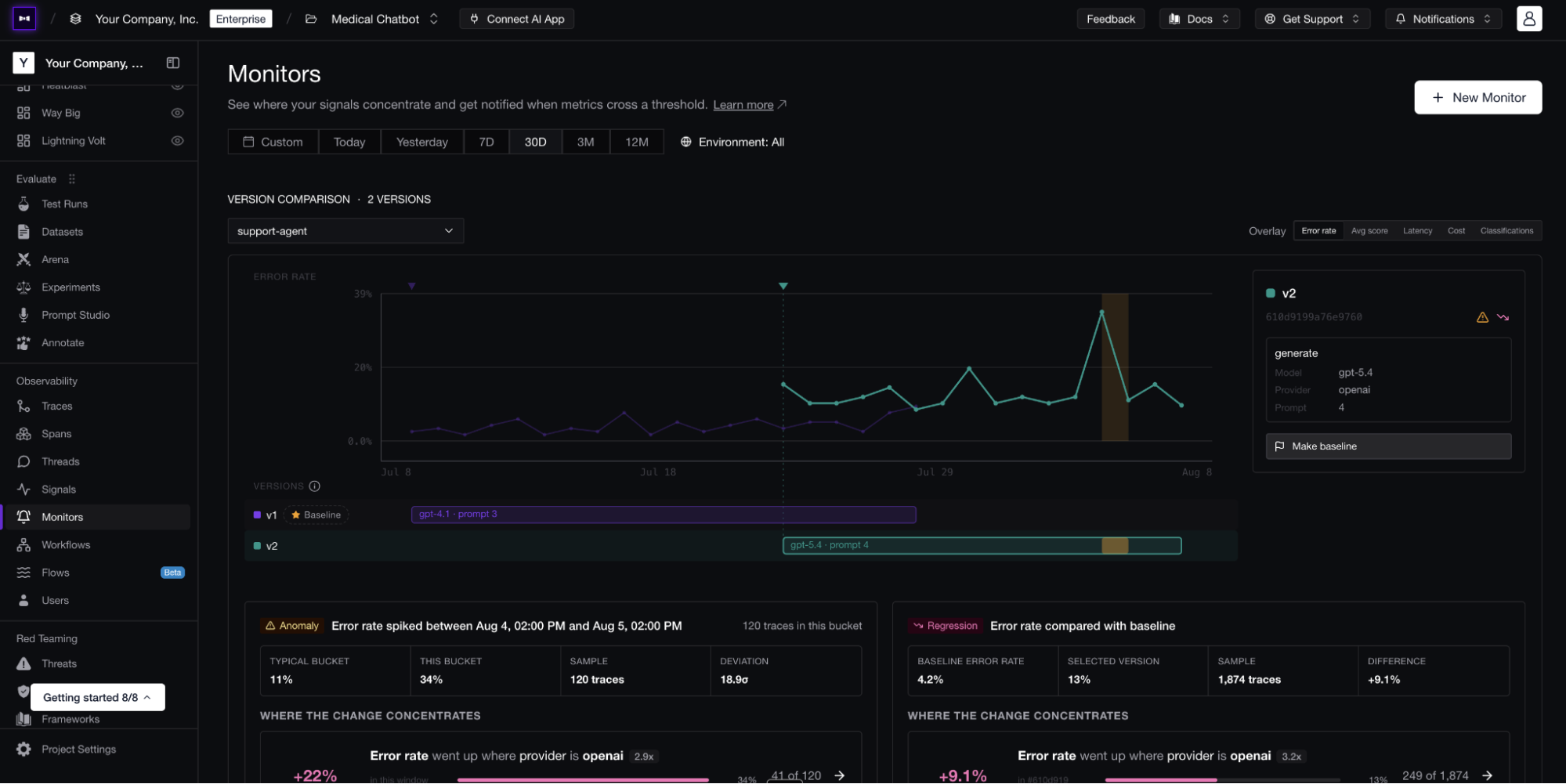
Confident AI is the AI quality platform built by the creators of DeepEval, an open-source LLM evaluation framework. DeepEval supports LLM unit and regression testing in development and CI/CD, while Confident AI adds collaboration, dataset management, prompt management, and monitoring.
Key Features
- DeepEval (Open-Source): Runs LLM unit and regression tests during development and CI/CD, with the open-source framework available for local testing
- No-Code Workflows: Build evaluation pipelines, custom metrics, and annotation queues without requiring code on paid plans
- Chat Simulations: Simulate multi-turn conversations to test chatbot and agent behaviour before release
- LLM Observability: Traces LLM calls, tool calls, latency, costs, and agent performance in production, with alerts for quality degradation
Pricing
Offers a free plan with 1 GB-month of tracing, two seats, and five test runs per week; Starter costs $200/month with unlimited seats and 5 GB-months of tracing; Team costs $2,000/month including 75 GB-months, SOC 2, and SSO; Enterprise pricing is custom.
Pros
- Open-source DeepEval for LLM unit and regression testing
- Unlimited seats on the $200/month Starter plan
- Strong focus on testing, alongside production monitoring
Cons
- Big jump from free (2 seats, 5 runs per week) to $200 per month
- Newer cloud platform than established competitors
Best For: Developer-led teams already running tests in CI/CD that want an open-source eval framework with optional cloud.
10. Helicone
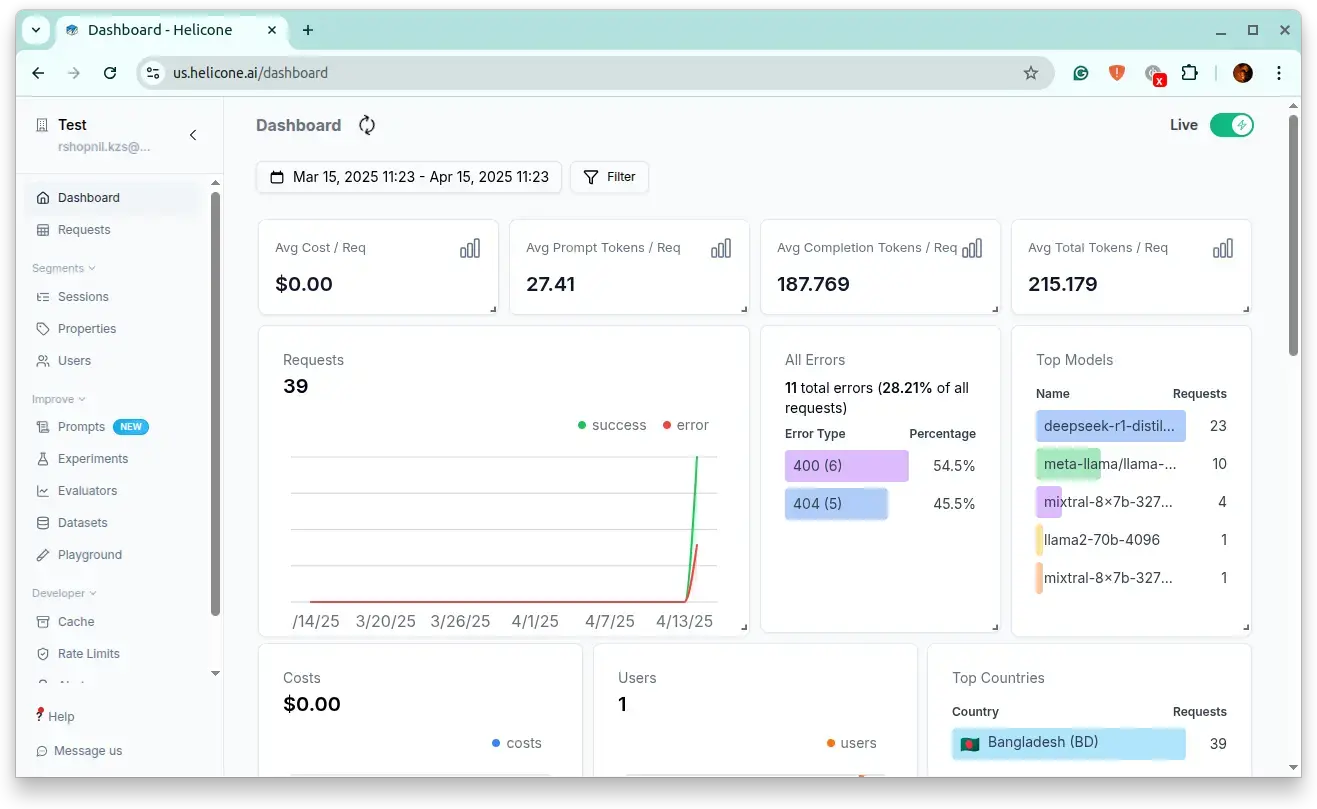
Helicone’s a lightweight observability platform for request logging and cost tracking. Its proxy and gateway integrations provide request logging and cost tracking, while its AI Gateway supports access to 100+ models through a unified OpenAI-compatible interface.
Key Features
- One-Line Integration: Adds Helicone as a proxy with a single code change
- Cost Tracking: Monitors AI spending across models, providers, users, projects, and features with request-level cost analytics
- HQL Query Language: Write custom queries against request logs for deeper analysis.
- AI Gateway: Provides access to 100+ models through a unified OpenAI-compatible API, with routing, fallbacks, caching, and built-in observability
Pricing
Helicone offers a free Hobby plan with 10,000 requests, 1 seat, and 7-day retention. Pro costs $79/month with unlimited seats and 1-month retention; Team is $799/month with 3-month retention; Enterprise pricing is custom.
Pros
- One-line integration for request logging and observability; minimal setup
- Cost tracking across models, providers, users, and features
- Discounts for students, startups, nonprofits, and open-source projects
Cons
- Maintenance mode following Mintlify acquisition in March 2026
- Seat and retention limitations on Hobby
Best For: Teams that need cost tracking and request logging with minimal setup.
Selection Criteria
How We Evaluated Langfuse Alternatives
For this review, we looked at five factors across these ten tools:
- First, does the tool test agents before deployment or only monitor them after?
- How does pricing scale with team and traffic growth?
- Does it support independent verification?
- How deep are the evaluation and testing features?
- And finally, how mature is the platform?
How To Choose Your AI Agent Testing Tool
If you need to test agents before production with independent results, VerifyAX is built for that. If you’re deep in the LangChain ecosystem and need tracing, LangSmith is the natural pick.
For open-source flexibility, Arize Phoenix or DeepEval give you a self-hosted foundation. If budget is tight, Maxim AI and LangWatch both offer strong value at low per-seat costs.
Start Verifying Your Agents Before They Go Live
Most tools on this list observe what AI agents do after deployment. A few go further with evaluation benchmarks, but VerifyAX adds an independent verification layer before your agents reach a single user.
VerifyAX puts your AI agents through realistic simulated conditions and scores them independently across five dimensions, giving your team audit-grade reports to support deployment and governance decisions.
Start a free trial and see how your AI agents perform before they go live.
FAQs
Is Langfuse free?
Langfuse offers a free Hobby plan with 50,000 units per month, 30 days of data access, and two users. It’s also open source under MIT, so you can self-host at no cost beyond your own infrastructure. Paid Cloud plans start at $29 per month.
What’s the difference between observability and verification?
Observability means watching what your AI agent does in production. It’ll tell you what happened and help you debug. Verification means testing your agent before deployment to check that it handles tough scenarios safely. You’ll usually need both, but observability alone can’t tell you whether you should’ve deployed an agent.
Can I self-host any of these tools?
Yes, several. Langfuse, Arize Phoenix, LangWatch, and DeepEval are free to self-host. LangSmith, Confident AI, and Braintrust offer self-hosted deployment on Enterprise plans. Check vendors’ docs to confirm their options.
Do I need a testing tool if I already use Langfuse?
If your agents handle low-risk tasks and you’re mostly debugging, Langfuse’s built-in evaluations may be enough. But if your agents affect real users or regulated processes, that’s different. A tool like VerifyAX adds independent assurance that monitoring alone can’t provide.