Quick Summary
Langfuse vs LangSmith explores how they each approach tracing, evaluation, and prompt management for LLM applications. Langfuse is open-source and self-hostable, while LangSmith offers deep LangChain integration and fast cloud performance through SmithDB. LangSmith also supports offline evaluation, but VerifyAX adds truly independent, third-party pre-deployment verification for production AI agents.
|
Langfuse |
LangSmith |
|
|
Pricing |
Free tier, then $29/mo (usage-based, unlimited users) |
Free tier, then $39/seat/mo (per-seat + usage) |
|
Tracing |
Hierarchical, OpenTelemetry-native, ClickHouse backend |
Hierarchical, OpenTelemetry support, SmithDB backend |
|
Evaluation |
LLM-as-judge, human review, code evaluators |
LLM-as-judge, human review, code, pairwise evaluators |
|
Self-hosting |
Free, MIT-licensed open-source option |
Enterprise-only |
|
Integrations |
100+ tools, framework-agnostic |
Framework-agnostic, deep LangChain/LangGraph integration |
|
Best for |
Open-source flexibility, self-hosting, and cost control |
LangChain/LangGraph teams and advanced cloud tooling |
|
Key limitation |
Some self-hosted features require a commercial licence |
Self-hosting requires Enterprise |
What Separates Langfuse From LangSmith
For a workload of 500,000 monthly traces, with 10 spans and one score per trace, 12-month retention, and five users, Langfuse costs about $621 per month compared with roughly $3,895 for LangSmith.
That gap alone gives AI teams a reason to compare the two closely. However, pricing is only one of six dimensions that separate them, and both are strong observability platforms.
Your framework choice, hosting requirements, data control, and evaluation workflow also shape how your team builds and manages AI applications in production. We’ve compared Langfuse vs LangSmith across these areas to help you decide which actually fits your stack.
Why Listen to Us?
Daniel Hulme, founder and CEO of Conscium, ranks 25th among the top 100 global AI leaders and serves as Chief AI Officer at WPP. We built VerifyAX after seeing organisations struggle to deploy AI agents with confidence.
Some teams build and test their own agents, which is much like grading their own homework, while others stall in the build phase. That experience gives us a clear view of where observability and evaluation tools like Langfuse and LangSmith fit, and where independent verification can close the gap.
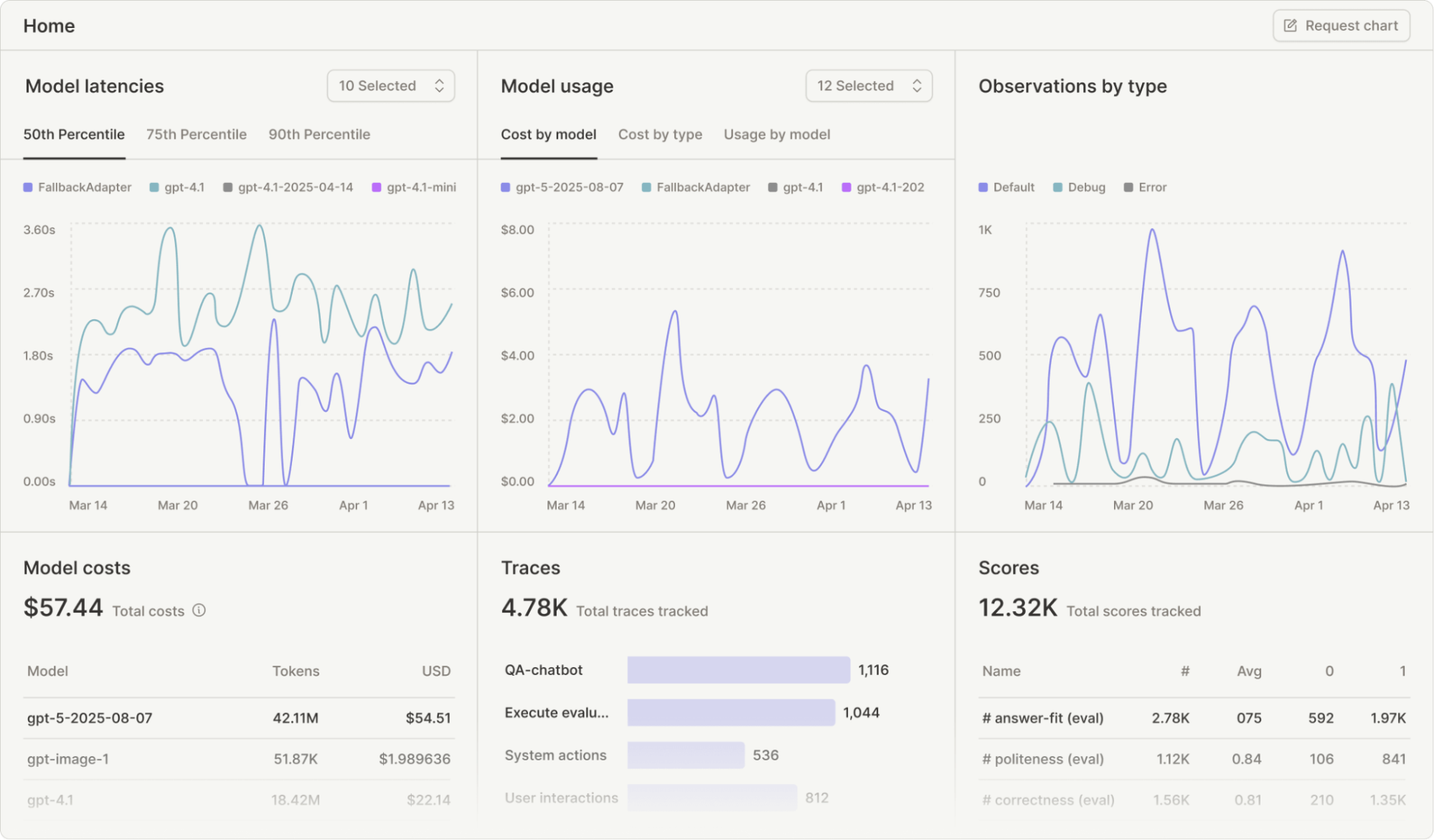
Langfuse is an open-source platform for tracing, evaluating, and managing LLM applications. ClickHouse acquired it in January 2026. Langfuse says it now processes over 90 billion observations monthly across more than 50,000 companies.
You can run it as a managed cloud service in the US, EU, or Japan. You can also self-host it for free under an MIT licence. The self-hosted version includes all core platform features, though some enterprise governance features require a commercial licence.
Langfuse is framework-agnostic and built on OpenTelemetry. It connects with over 100 tools, including LangChain, LlamaIndex, CrewAI, Pydantic AI, and other model providers and frameworks.
What is LangSmith?
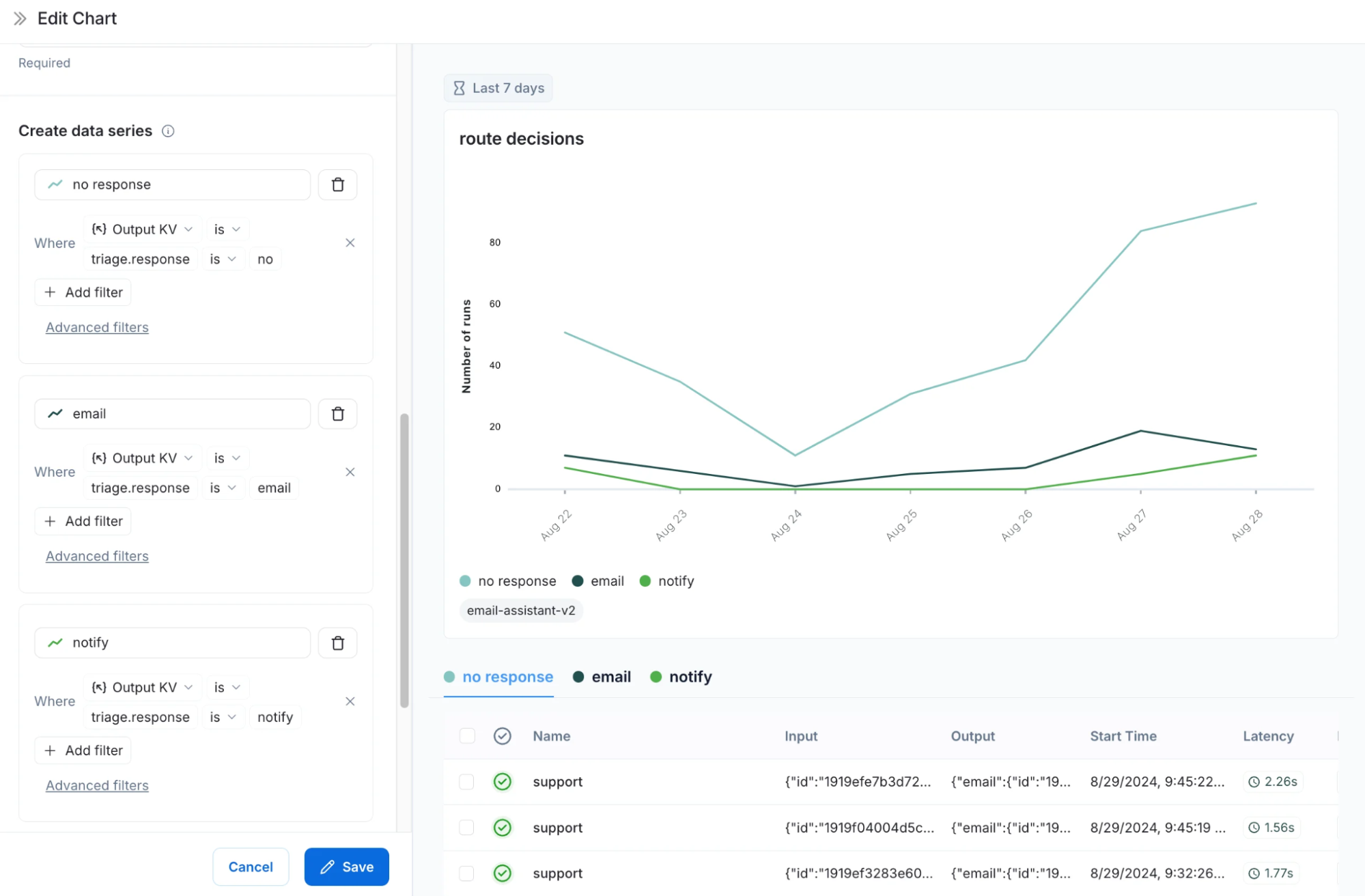
LangSmith is LangChain’s observability and evaluation platform for LLM applications. Companies like Autodesk, Workday, Nvidia, and Coinbase use it in production.
LangChain launched SmithDB in May 2026. It’s a Rust-based data layer that now handles all US Cloud ingestion. LangChain reports P50 trace-tree load times of 92 milliseconds.
LangSmith has SDKs for Python and TypeScript. Applications written in other languages, including Go and Java, can send traces through OpenTelemetry. It integrates closely with LangChain and LangGraph and also supports OpenTelemetry and Vercel AI SDK integrations. You’ll get the smoothest setup if you’re already building with LangChain or LangGraph.
Langfuse vs LangSmith Pricing Comparison
Pricing is where these two diverge the most.
Langfuse starts free with 50,000 units per month and two users. The Core tier is $29 per month with unlimited users and 100,000 units included. Pro is $199 per month and adds three years of data retention plus SOC 2 and ISO 27001 reports. Enterprise starts at $2,499 per month. Additional usage starts at $8 per 100,000 units, with lower rates at higher volumes.
LangSmith starts free with 5,000 base traces per month and one seat. Plus costs $39 per seat per month with 10,000 base traces included. Enterprise pricing isn’t public.
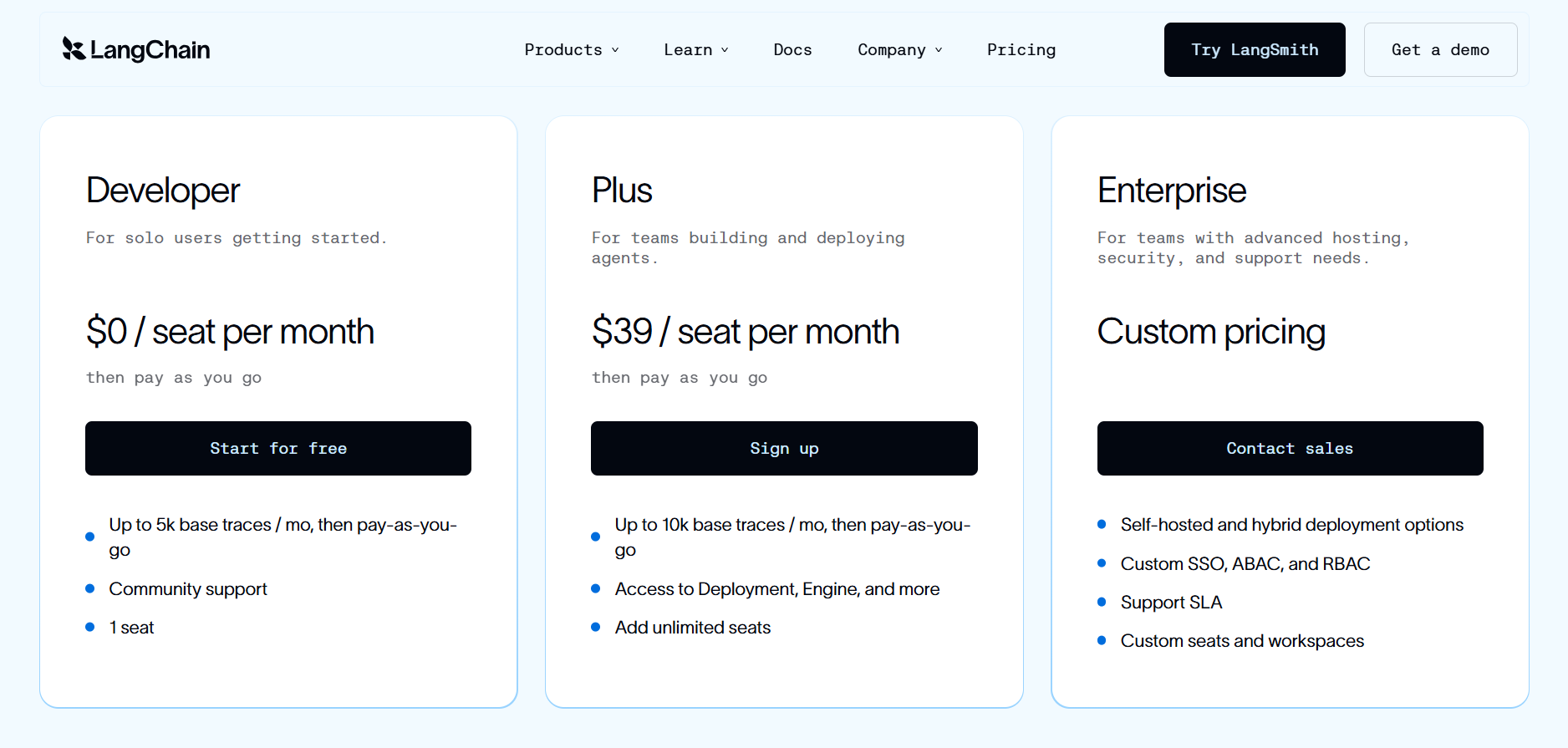
The structural difference matters at scale. Langfuse charges by usage and includes unlimited users on its paid cloud plans, while LangSmith charges per seat in addition to usage. That means adding team members directly increases the seat component of your LangSmith bill.
Retention works differently too. LangSmith retains base traces for 14 days, while extended traces can be retained for 400 days for an additional fee. Langfuse Pro includes three years of data access.
Tracing and Observability
Both platforms capture hierarchical traces across LLM calls, tool use, and other steps in an application.
Langfuse stores traces in ClickHouse and added full-text search in May 2026. In one benchmark, a large input/output search that previously took 18.2 seconds completed in 0.447 seconds with full-text search, although performance varies by query and data distribution.
LangSmith’s SmithDB gives cloud users trace-tree loading at 92 ms P50, alongside full-text search, JSON filtering, and tree-aware queries. LangSmith Engine goes further by analysing traces to identify recurring issues and propose fixes.
Evaluation Features
Both tools support LLM-as-a-judge scoring, human annotation, and deterministic code evaluators. Both let you build datasets and run experiments to compare different prompt or model configurations side by side.
Langfuse runs evaluations in two modes. Online scoring checks live production traces, and offline evaluation runs against predefined datasets. You can also wire evaluations into CI/CD with GitHub Actions to automatically block regressions.
LangSmith adds pairwise evaluation, where it compares two outputs head-to-head. It launched Tuned Evaluators in August 2026, starting with Perceived Error detection that flags problematic interactions automatically. If you’re using LangGraph, evaluation plugs directly into your agent workflows.
Self-hosting and Data Control
This is one of the clearest gaps between the two.
Langfuse is MIT-licensed and self-hostable. Deploy with Docker Compose for smaller setups or Kubernetes via Helm for production. Self-hosted Langfuse runs the same core infrastructure that powers Langfuse Cloud, although some add-on features require a licence key.
LangSmith offers self-hosted and hybrid deployment through its Enterprise plan. If you need to keep your observability infrastructure on your own systems without an Enterprise contract, Langfuse gives you a self-hosted open-source option.
Integrations and Framework Support
Langfuse takes a framework-agnostic approach. It’s built on OpenTelemetry and works with over 100 tools and frameworks. You can use it with LangChain, LangGraph, LlamaIndex, CrewAI, or your own custom framework.
LangSmith is also framework-agnostic, but gives you particularly tight integration with LangChain and LangGraph. It also supports OpenTelemetry and other popular frameworks and SDKs. You can use LangSmith outside the LangChain ecosystem, but LangChain and LangGraph users get the most direct integration.
When to Pick Langfuse and When to Pick LangSmith
Pick Langfuse if you want open-source flexibility, need to self-host without an Enterprise contract, care about cost at production volume, or work across multiple frameworks. If you have high trace volumes or strict data residency needs, its usage-based pricing and MIT-licensed self-hosting are key advantages.
Pick LangSmith if you’re building with LangChain and LangGraph, want SmithDB’s cloud performance, or need automated issue detection and root-cause analysis through Engine. LangSmith fits particularly well when you’re already working inside the LangChain ecosystem.
It’ll usually come down to framework commitment, cost, and how you plan to deploy. Both platforms are strong on core observability and evaluation capabilities.
VerifyAX by Conscium: A Better Alternative for AI Agent Verification
Langfuse and LangSmith both cover observability and evaluation. They let you trace agent behaviour, score outputs, build datasets, run evaluations, and investigate failures. LangSmith also supports offline evaluation and can use Engine to red-team agents before production.
But evaluation and observability aren’t the same as verification. An agent can perform well in evaluations and still behave unpredictably when it hits edge cases, adversarial inputs, or conditions your tests didn’t cover. And when the same organisation builds and tests an agent, it’s still grading its own homework.
Independent verification adds an external layer of confidence before deployment. It tests whether an AI agent can do its job under realistic conditions by exposing it to simulated scenarios, edge cases, and failure conditions before it goes live.
VerifyAX fills this third-party testing gap. We run AI agents through functional and non-functional testing, plus simulation tests across realistic scenarios.
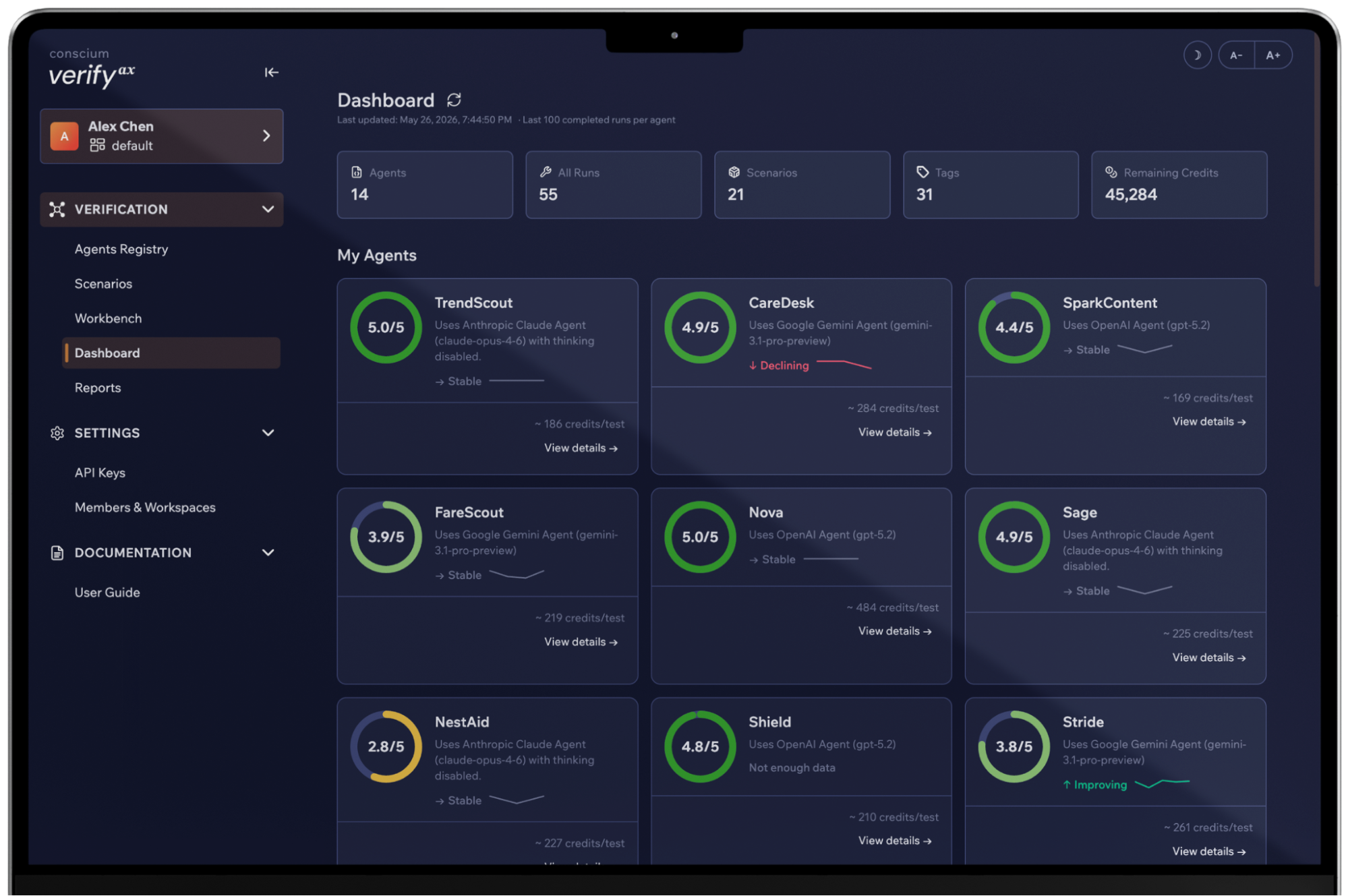
What VerifyAX Does:
- Benchmark Testing: Tests your agent against text, images, tables, CSV, Excel, and PDF. Also uses synthetic data generation to stress-test under controlled conditions
- Tool and Workflow Evaluation: Evaluates how your agent uses enterprise tools like email, Jira, Slack, and more. It scores workflow completion, output correctness, process efficiency, and consistency for each run
- Multi-agent Simulation: Gives AI agents high-level objectives and deploys synthetic NPC agents with distinct personalities and assignments to introduce constraints and test complex interactions
- Agent Scoring: Gives every agent a clear, evidence-backed score for each functional and non-functional test it runs
- Audit-Grade Reporting: Documents agent behaviour after every run with transcripts, explanations, and recommendations. Tracks policy enforcement and compliance across your AI portfolio
VerifyAX is cost-effective and easy to get started with. It catches AI agent failures before deployment and keeps verifying them in production, alerting you when an agent needs retesting after an update or model change.
Verify Before You Deploy
Compare Langfuse vs LangSmith, and you’ll find that while both provide observability and evaluation for AI applications, they differ in several areas. Both platforms help teams evaluate and monitor agent behaviour across the agent lifecycle; LangSmith also supports offline evaluation, which can aid pre-deployment evaluation.
The gap is independent, third-party verification before deployment. VerifyAX independently tests AI agents against realistic simulated scenarios before they go live, offering enterprise AI teams an external layer of assurance.
Start a free trial with 500 credits and no credit card.
FAQs
Is Langfuse really free?
Langfuse’s Hobby tier is free with 50,000 units per month and two users. The self-hosted version is also free under an MIT licence and includes all core features. Paid tiers start at $29 per month for higher usage or longer data retention.
Does LangSmith work without LangChain?
Yes. LangSmith supports OpenTelemetry and offers Python and TypeScript SDKs. Applications using Go, Java, and other languages can send traces through OpenTelemetry. You can also use LangSmith with other frameworks and model providers without LangChain.
Can I self-host LangSmith?
Yes, on the Enterprise tier. LangSmith offers self-hosted deployment for Enterprise customers, including SmithDB in your VPC. Langfuse offers free self-hosting under its MIT licence.
What’s the difference between observability and verification?
Observability gives you visibility into agent behaviour through tracing, monitoring, and evaluation. Verification tests agents before deployment by running them through realistic simulated scenarios and edge cases. VerifyAX adds independent, third-party testing to that process.