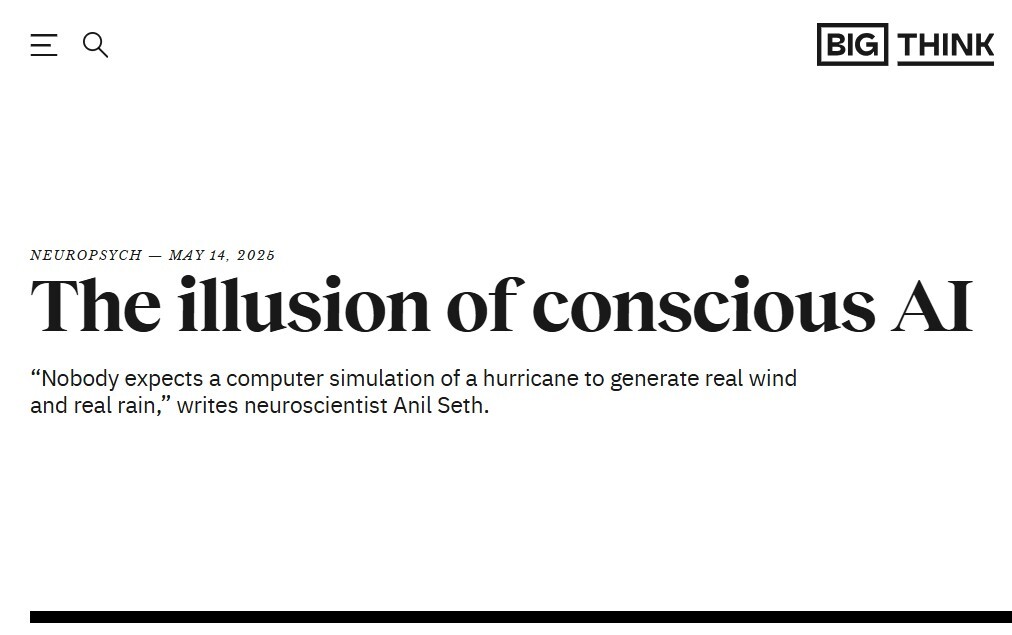
Anil Seth, the neuroscientist who advises Conscium on the science of consciousness, wrote a piece for Big Think that I think every AI leader confidently predicting conscious chatbots within the decade should sit with. His argument, in short: machine consciousness is possible in principle, but very unlikely to show up in large language models specifically, and the reasons people assume otherwise are mostly psychological rather than scientific.
Why we assume intelligence and consciousness go together
Seth's first point is about a bias baked into how humans experience the world. In us, intelligence and consciousness happen to coexist, so we've come to treat them as the same phenomenon, or at least as necessarily linked. Language makes this worse. People ask whether a chatbot like Claude might be conscious, but nobody asks the same question about a protein-folding algorithm, even though both are just software solving problems. The instinct to ask the question at all says more about how the system talks to us than about what's happening inside it.
The brain is not a computer, and that matters more than it sounds
The second, and I think the strongest, part of his argument is a direct challenge to the assumption underpinning most machine consciousness speculation: that the brain is essentially a biological computer, so a sufficiently advanced digital computer should eventually replicate what it does, including consciousness. Seth argues the opposite. The more closely neuroscience examines the brain, the less it resembles a computer, there's no clean separation between hardware and software, and individual neurons are themselves staggeringly complex biological systems, not simple switches. His analogy is a useful gut check: nobody expects a simulation of a hurricane on a computer to produce actual wind and rain. A sufficiently detailed simulation of a brain might likewise only simulate consciousness rather than generate the real thing.
Life, not information processing, might be the missing ingredient
Where Seth goes further than most sceptics is in offering an actual alternative rather than just poking holes. His suggestion is that consciousness might be tied to being alive, to the biological processes of living systems, rather than to information processing as an abstract, substrate-independent property. If he's right, that reframes the whole debate: it's not that AI consciousness is either coming soon or philosophically impossible, it's that we've been looking for it in the wrong category entirely.
Why this matters even if you don't believe current AI is conscious
Seth's conclusion is one I fully agree with, and it's the reason Conscium exists in the form it does. He argues against deliberately trying to build conscious AI given how much uncertainty remains, and warns that AI which merely appears conscious is already a real ethical problem, because it can exploit deeply wired human psychological instincts regardless of what's actually happening computationally inside the system. You don't need to resolve the philosophy to see the risk.
Read Anil's full piece on Big Think.